Section 4.3
Classification of finitely generated modules over a PID
For vector spaces, we had this classification theorem.
Every vector space $V$ over a field $k$ is isomorphic to $V \cong k^{\oplus S}$ for some set $S$. (In other words, every vector space has a basis.)
Can we expect this to be true for rings as well? For instance, take $R = \mathbb{Z}$. There are modules like $\mathbb{Z}^{\oplus 3}$, but there are also modules like $\mathbb{Z}/10\mathbb{Z}$. You can also mix these sorts of modules and have $\mathbb{Z}^{\oplus 2} \oplus \mathbb{Z}/2\mathbb{Z} \oplus \mathbb{Z}/4\mathbb{Z}$. Such modules are clearly not free, because a nonzero scalar like $4$ can annihilate nonzero elements of the module. But we still can expect some nice things to happen, in nice cases.
An $R$-module $M$ is said to be finitely generated if there exists a finite number of elements $x_1, \ldots, x_n \in M$ such that every $x \in M$ can be written as
$$ x = a_1 x_1 + \cdots + a_n x_n $$
for $a_1, \ldots, a_n \in R$.
The result we are going to prove is that if the base ring $R$ is a principal ideal domain and $M$ is finitely generated over $R$, then $M$ has a particular structure.
Let $R$ be a principal ideal domain. For every finitely generated module $M$ over $R$, there exists a nonnegative integer $n \ge 0$ and a sequence of ideals
$$ (0) \subseteq \mathfrak{a}_1 \subseteq \mathfrak{a}_2 \subseteq \cdots \subseteq \mathfrak{a}_n \subsetneq R $$
such that
$$ M \cong (R / \mathfrak{a}_1) \oplus (R / \mathfrak{a}_2) \oplus \cdots \oplus (R / \mathfrak{a}_n). $$
Moreover, $n$ and $\mathfrak{a}_1, \ldots, \mathfrak{a}_n$ is uniquely determined by $M$.
Before start proving it, let us see what the theorem implies. Take $R = \mathbb{Z}$. Then every ideal $\mathfrak{a} \subseteq \mathbb{Z}$ looks like $(d) \subseteq \mathbb{Z}$. So the sequence of ideals look like
$$ (0) \subseteq (0) \subseteq \cdots \subseteq (0) \subseteq (d_r) \subseteq (d_{r-1}) \subseteq \cdots \subseteq (d_1) $$
for $d_1, \ldots, d_r > 0$. The conditions $(d_{i+1}) \subseteq (d_i)$ imply that $d_i \mid d_{i+1}$. So then $M$ can be written like
$$ M \cong \mathbb{Z}^{\oplus (n-r)} \oplus (\mathbb{Z}/d_1\mathbb{Z}) \oplus \cdots \oplus (\mathbb{Z}/d_r\mathbb{Z}), $$
where $d_1 \mid d_2 \mid \cdots \mid d_r$ where $d_1, \ldots, d_r$ are positive integers. Once we have this structure theorem, it can be used for explicit computations.
Let $M$ be a $\mathbb{Z}$-module that is finite (as a set). Assume that for each positive integer $k > 0$, there are at most $k$ elements $x \in M$ such that $kx = 0$. Show that $M$ must be of the form $M \cong \mathbb{Z} / n\mathbb{Z}$ for some $n \ge 0$.
Let $p$ be a prime number, and consider the field $\mathbb{F}_p = \mathbb{Z}/p\mathbb{Z}$. Take its multiplicative group
$$ \mathbb{F}_p^\times = (\mathbb{Z}/p\mathbb{Z})^\times = (\mathbb{Z}/p\mathbb{Z}) \setminus \lbrace [0]\rbrace = \lbrace [1], \ldots, [p-1]\rbrace . $$
- (a)
For any positive integer $k$, show that the equation $x^k \equiv 1 \bmod{p}$ has at most $k$ solutions $x \in (\mathbb{Z}/p\mathbb{Z})^\times$.
- (b)
Using the previous exercise, show that $(\mathbb{Z}/p\mathbb{Z})^\times$ is isomorphic to $\mathbb{Z}/(p-1)\mathbb{Z}$ as a group. In other words, the prime $p$ has a primitive root.
Let us now start proving the theorem. Because $M$ is a finitely generated module, there exists a surjective $R$-linear homomorphism
$$ R^{\oplus n} \twoheadrightarrow M \to 0. $$
Then we can look at the kernel
$$ 0 \to N \hookrightarrow R^{\oplus n} \twoheadrightarrow M \to 0. $$
The kernel $N$ is going to be a submodule of $R^{\oplus n}$.
If $R$ is a principal ideal domain, then every submodule of a free module is free. Moreover, every submodule of a free module with finite basis is free with finite basis.
By this theorem, we can find an isomorphism $N \cong R^{\oplus k}$ for some $k$. Hence we may write our short exact sequence as
$$ 0 \to R^{\oplus k} \xrightarrow{A} R^{\oplus n} \twoheadrightarrow M \to 0. $$
The module $M$ is the cokernel of the linear map $A$, so it will be useful to analyze the linear map $A$ up to composition by isomorphisms. Here, $A : R^{\oplus k} \to R^{\oplus n}$ can be regarded as an $n \times k$ matrix with entries in $R$.
Let $R$ be a principal ideal domain, and let $A$ be an $n \times k$ matrix with entries in $R$. Then there exists an invertible $n \times n$ matrix (i.e., an invertible linear map) $P$ and an invertible $k \times k$ matrix $Q$ such that $PAQ$ is of the form
$$ PAQ = \begin{bmatrix} d_1 & \cdots & 0 & 0 & \cdots & 0 \\ \vdots & \ddots & \vdots & \vdots & \ddots & \vdots \\ 0 & \cdots & d_r & 0 & \cdots & 0 \\ 0 & \cdots & 0 & 0 & \cdots & 0 \\ \vdots & \ddots & \vdots & \vdots & \ddots & \vdots \\ 0 & \cdots & 0 & 0 & \cdots & 0 \end{bmatrix}, $$
where $d_1 \mid d_2 \mid \cdots \mid d_r$. This is sometimes called the Smith normal form of $A$.
Recall that we have a short exact sequence
$$ 0 \to R^{\oplus k} \xrightarrow{A} R^{\oplus n} \xrightarrow{B} M \to 0. $$
Because $P$ and $Q$ are isomorphisms from $R^{\oplus k}$ and $R^{\oplus n}$ to themselves, it is not hard to see that
$$ 0 \to R^{\oplus k} \xrightarrow{PAQ} R^{\oplus n} \xrightarrow{B P^{-1}} M \to 0 $$
is also short exact.
Verify the above claim, that the modified sequence is short exact.
As a consequence, we have an isomorphism
$$ M \cong R^{\oplus n} / \im(PAQ). $$
Because we know exactly what $PAQ$ looks like, the right hand side can be computed. It follows that
$$ M \cong R^{\oplus (n-r)} \oplus (R / d_1 R) \oplus \cdots \oplus (R / d_r R). $$
If we let $\mathfrak{a}_1 = \cdots = \mathfrak{a}_{n-r} = (0)$ and $\mathfrak{a}_{n-r+i} = (d_i)$, then we can write this also as
$$ M \cong \bigoplus_{i=1}^{n} (R / \mathfrak{a}_i). $$
This proves the existence part of the classification theorem (Theorem 4.3.3).
Compute $R^{\oplus n} / \im(PAQ)$ and show that it is isomorphic to $R^{\oplus (n-r)} \oplus (R / d_1 R) \oplus \cdots \oplus (R / d_r R)$.
I now owe you the proof of two theorems: Theorem 4.3.4 and Theorem 4.3.5.
We need to prove that any submodule of $R^{\oplus S}$ is free. But here, we will only prove this in the case when $S$ is a finite set.
We show that any submodule of $R^{\oplus n}$ is free, by induction on $n$. If $n = 0$, we have $R^{\oplus n} \cong 0$ and so there is nothing to prove.
Assume that the claim is true for $n-1$. For an arbitrary submodule $N \subseteq R^{\oplus n}$, we want to prove that $N$ is free. If we consider
$$ N^\prime = N \cap (\lbrace 0\rbrace \oplus R^{\oplus (n-1)}) \subseteq \lbrace 0\rbrace \oplus R^{\oplus (n-1)}, $$
this is a submodule of $R^{\oplus (n-1)}$. Then $N^\prime$ is a free module, because $N^\prime$ is a submodule of $R^{\oplus (n-1)}$.
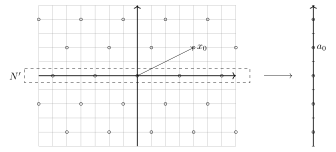
Generators are selected successively inside a submodule of a free module, illustrating how a basis for the submodule is constructed.
Consider the composite $R$-linear map
$$ \varphi : N \hookrightarrow R^{\oplus n} \xrightarrow{\pi_1} R $$
where $\pi_1 : R^{\oplus n} \to R$ is given by projection $(x_1, \ldots, x_n) \mapsto x_1$. Then the image of $N \to R$ is going to be submodule of $R$, which is going to be an ideal. Because $R$ is a principal ideal domain, $\im \varphi = (a_0)$ for some $a_0 \in R$. Note that we have a short exact sequence
$$ 0 \to N^\prime \hookrightarrow N \xrightarrow{\varphi} \im(\varphi) = (a_0) \to 0. $$
If $a_0 = 0$, then $\im \varphi = (0)$ and so $N$ is actually contained in $\lbrace 0\rbrace \oplus R^{\oplus (n-1)}$. Then $N = N^\prime$ is a free module.
Suppose now that $a_0 \neq 0$. Then $a_0 \in \im \varphi$ shows that there exists an $x_0 \in N$ such that $\pi_1(x_0) = a_0$. Using this, we may define the map
$$ N^\prime \oplus R \to N; \quad (x, a) \mapsto x + a x_0. $$
This is clearly an $R$-linear map. We claim that it is bijective. To show that it is injective, suppose that $x + a x_0 = 0$. Applying $\pi_1$ to both sides gives $0 = \pi_1(x) + a \pi_1(x_0) = a a_0$ because $\pi_1(x) = 0$ for $x \in N^\prime$ and $\pi_1(x_0) = a_0$. Then $a_0 \neq 0$ and $a a_0 = 0$ implies $a = 0$ because $R$ is a PID. It follows that $0 = x + ax_0 = x$.
To show that it is surjective, we consider an arbitrary $y \in N$ and check that it can be written as $y = x + a x_0$ for $x \in N^\prime$ and $a \in R$. Because $\pi_1(y) \in \im \varphi = (a_0)$, we can write $\pi_1(y) = a a_0$ for some $a \in R$. Then $\pi_1(y - a x_0) = \pi_1(y) - a \pi_1(x_0) = 0$ and $y - a x_0 \in N$ because $y \in N$ and $x_0 \in N$. Therefore $x = y - a x_0 \in N^\prime$ so that $y = x + a x_0$ for $x \in N^\prime$ and $a \in R$. This shows that $\varphi : N^\prime \oplus R \to N$ is an isomorphism of $R$-modules. Because $N^\prime$ is free, $N \cong N^\prime \oplus R$ is also free.
The intuition is that we can find a basis for $N$ by looking at the sequence
$$ \begin{aligned} & N \cap (\lbrace 0\rbrace \oplus \cdots \oplus \lbrace 0\rbrace ) = 0, \\ & N \cap (\lbrace 0\rbrace \oplus \cdots \oplus \lbrace 0\rbrace \oplus R), \ldots, \\ & N \cap (\lbrace 0\rbrace \oplus R \oplus \cdots \oplus R), \\ & N \cap (R \oplus \cdots \oplus R) = N \cap R^{\oplus n} = N \end{aligned} $$
and extending the basis one at a time. To prove the theorem in the infinite rank case, we need to use Zorn's lemma.
Prove the above theorem as follows. Let $R^{\oplus S}$ be our free module and $N \subseteq R^{\oplus S}$ be the submodule. We want to show that $N$ is free. For a subset $T \subseteq S$, we have a submodule $R^{\oplus T} \subseteq R^{\oplus S}$. Consider the set
$$ \lbrace (T, \mathcal{B}) : \mathcal{B} \text{ is a basis of } N \cap R^{\oplus T} \rbrace $$
and equip it with the partial order defined by $(T_1, \mathcal{B}_1) \prec (T_2, \mathcal{B}_2)$ if and only if $T_1 \subseteq T_2$ and $\mathcal{B}_1 \subseteq \mathcal{B}_2$. Apply Zorn's lemma (Lemma 2.7.5) to this partially ordered set.
For $n$ a nonnegative integer, consider a submodule $N \subseteq R^{\oplus n}$. Show that there exists an integer $k \le n$ such that $N \cong R^{\oplus k}$. (We do not know yet that $k$ is uniquely determined by $N$.)
Recall the second ingredient of the proof.
Recall from Section 3.4 that multiplying an elementary matrix from the left is doing an elementary row operation.
Similarly, define what an elementary column operation is, and verify that multiplying an elementary matrix from the right is doing an elementary column operation.
So what we need to do is to take an arbitrary matrix $A$, multiply invertible matrices or do elementary row and elementary column operations, and make it into a diagonal matrix. One thing to be careful is that we need all our operations to be invertible. So when we do the second operation, i.e., multiplying a row/column by a constant, we are allowed to only multiply by an element that divides $1$. (These are called units.) To keep things simple, we just won't use the second elementary operation.
The proof is really combinatorial in nature. We first study some basic properties of principal ideal domains.
Let $R$ be a principal ideal domain, and consider $x_1, \ldots, x_n \in R$. Then there exists an element $d \in R$ satisfying the following:
- (a)
$d$ divides $x_1, \ldots, x_n$.
- (b)
there exist $a_1, \ldots, a_n \in R$ such that $d = a_1 x_1 + \cdots + a_n x_n$.
- (c)
if $e \in R$ divides $x_1, \ldots, x_n$, then $e$ divides also $d$.
Consider the ideal
$$ I = \lbrace a_1 x_1 + \cdots + a_n x_n : a_1, \ldots, a_n \in R \rbrace \subseteq R. $$
Because $R$ is a principal ideal, there exists a $d \in R$ such that $I = (d)$. Then (a) follows from $x_1, \ldots, x_n \in I = (d)$, and (b) follows from $d \in (d) = I$. It is also clear that (b) implies (c).
Let $R$ be a principal ideal domain. If $x_1, \ldots, x_n \in R$, we will call this $d = \gcd(x_1, \ldots, x_n)$ from Lemma 4.3.6 a greatest common divisor of $x_1, \ldots, x_n$. (Note that a greatest common divisor is not unique, since it is possible that $(d) = (d^\prime)$ for $d \neq d^\prime$.)
Let $R$ be a principal ideal domain. If
$$ \mathfrak{a}_1 \subseteq \mathfrak{a}_2 \subseteq \mathfrak{a}_3 \subseteq \cdots \subseteq R $$
is a sequence of ideals, then there exists a positive integer $n$ such that $\mathfrak{a}_n = \mathfrak{a}_{n+1} = \cdots$. (This is saying that $R$ is Noetherian.)
If we define
$$ \mathfrak{a} = \bigcup_{i=1}^\infty \mathfrak{a}_i, $$
this is an ideal of $R$. Because $R$ is a principal ideal domain, we have $\mathfrak{a} = (x)$ for some $x$. This means that $x \in \mathfrak{a} = \bigcup_{i=1}^\infty \mathfrak{a}_i$, so $x \in \mathfrak{a}_n$ for some $n$. It follows that $(x) \subseteq \mathfrak{a}_n \subseteq \mathfrak{a} = (x)$, so $\mathfrak{a}_n = \mathfrak{a}_{n+1} = \cdots$.
Let us now describe the process.
Let $R$ be a principal ideal domain and consider $x_1, \ldots, x_n \in R$. Let $d = \gcd(x_1, \ldots, x_n)$. Then there exists an $n \times n$ invertible matrix $P$ such that
$$ P \begin{bmatrix} x_1 \\ x_2 \\ \vdots \\ x_n \end{bmatrix} = \begin{bmatrix} d \\ 0 \\ \vdots \\ 0 \end{bmatrix}. $$
We do this by induction on $n$. If $n = 1$, there is nothing to do. For $n = 2$, if $x_1=x_2=0$, then $d=0$ and we may take $P=I$. Otherwise, let $x_1 = d y_1$ and $x_2 = d y_2$, so that $\gcd(y_1, y_2) = 1$. Then what we are finding is a $2 \times 2$ invertible matrix $P$ such that
$$ d P \begin{bmatrix} y_1 \\ y_2 \end{bmatrix} = d \begin{bmatrix} 1 \\ 0 \end{bmatrix}. $$
Because $\gcd(y_1, y_2) = 1$, there exist $z_1, z_2 \in R$ such that $y_1 z_1 + y_2 z_2 = 1$. Then we have
$$ d \begin{bmatrix} z_1 & z_2 \\ -y_2 & y_1 \end{bmatrix} \begin{bmatrix} y_1 \\ y_2 \end{bmatrix} = d \begin{bmatrix} 1 \\ 0 \end{bmatrix}. $$
We check that the matrix is invertible because
$$ \begin{bmatrix} z_1 & z_2 \\ -y_2 & y_1 \end{bmatrix} \begin{bmatrix} y_1 & -z_2 \\ y_2 & z_1 \end{bmatrix} = \begin{bmatrix} 1 & 0 \\ 0 & 1 \end{bmatrix}. $$
Now assume we can find $P$ for $n-1$. Then there exists a matrix $P_0$ such that
$$ P_0 \begin{bmatrix} x_{n-1} \\ x_n \end{bmatrix} = \begin{bmatrix} \gcd(x_{n-1},x_n) \\ 0 \end{bmatrix}. $$
This means that if we put $1$s on the diagonal, we can build an $n \times n$ matrix $P_1$ such that
$$ P_1 \begin{bmatrix} x_1 \\ \vdots \\ x_{n-1} \\ x_n \end{bmatrix} = \begin{bmatrix} x_1 \\ \vdots \\ \gcd(x_{n-1}, x_n) \\ 0 \end{bmatrix}. $$
Now we can apply the inductive hypothesis and find another $n \times n$ matrix $P_2$ so that
$$ (P_2 P_1) \begin{bmatrix} x_1 \\ x_2 \\ \vdots \\ x_n \end{bmatrix} = P_2 \begin{bmatrix} x_1 \\ \vdots \\ \gcd(x_{n-1}, x_n) \\ 0 \end{bmatrix} = \begin{bmatrix} \gcd(x_1, \ldots, x_{n-2}, \gcd(x_{n-1}, x_n)) \\ 0 \\ \vdots \\ 0 \end{bmatrix}. $$
This is what we want, by the next exercise.
Assume that $R$ is a principal ideal domain. Then for $x_1, \ldots, x_n \in R$ we have
$$ \gcd(x_1, \ldots, x_n) = \gcd(x_1, \ldots, x_{n-2}, \gcd(x_{n-1}, x_n)). $$
Let $R$ be a principal ideal domain, and let $A$ be an $n \times k$ matrix with entries in $R$. By multiplying invertible matrices on the left and right of $A$, one can make $A$ into the form described in Theorem 4.3.5.
Let me describe the algorithm for doing this.
Step 1. First, we use Lemma 4.3.9 on the first column of $A$. Then we can multiply an invertible matrix on the left of $A$ to make it into
$$ \begin{bmatrix} d_1 & \ast & \cdots & \ast \\ 0 & \ast & \cdots & \ast \\ \vdots & \vdots & \ddots & \vdots \\ 0 & \ast & \cdots & \ast \end{bmatrix}. $$
If we use Lemma 4.3.9 on the first row, we can multiply an invertible matrix on the right and make it into
$$ \begin{bmatrix} d_2 & 0 & \cdots & 0 \\ \ast & \ast & \cdots & \ast \\ \vdots & \vdots & \ddots & \vdots \\ \ast & \ast & \cdots & \ast \end{bmatrix}. $$
Here, $d_2 = \gcd(d_1, \ast, \ldots, \ast)$ and so $d_2 \mid d_1$. Now we do this again and make it into
$$ \begin{bmatrix} d_3 & \ast & \cdots & \ast \\ 0 & \ast & \cdots & \ast \\ \vdots & \vdots & \ddots & \vdots \\ 0 & \ast & \cdots & \ast \end{bmatrix}. $$
As we repeat this process, we get a sequence of ideals
$$ (d_1) \subseteq (d_2) \subseteq (d_3) \subseteq \cdots $$
and thus by Lemma 4.3.8, the sequence stabilizes. In other words, $(d_{a+1}) = (d_a)$ for some $a$. Because $d_{a+1}$ is the greatest common divisor of everything in the first column and row, this means that when $d_a$ is the first row first column entry, every entry in the first row or column is divisible by $d_a$. Without loss of generality, we may assume that the matrix looks like
$$ \begin{bmatrix} d_a & d_a x_2 & \cdots & d_a x_k \\ 0 & \ast & \cdots & \ast \\ \vdots & \vdots & \ddots & \vdots \\ 0 & \ast & \cdots & \ast \end{bmatrix}. $$
By doing the elementary column operation that adds $(-x_i)$ times the first column to the $i$th column, we can make the matrix into
$$ \begin{bmatrix} d_a & 0 & \cdots & 0 \\ 0 & \ast & \cdots & \ast \\ \vdots & \vdots & \ddots & \vdots \\ 0 & \ast & \cdots & \ast \end{bmatrix}. $$
Step 2. Rewrite $e_1 = d_a$. Our matrix currently looks like
$$ \begin{bmatrix} e_1 & 0 & \cdots & 0 \\ 0 & \ast & \cdots & \ast \\ \vdots & \vdots & \ddots & \vdots \\ 0 & \ast & \cdots & \ast \end{bmatrix}. $$
If all the $\ast$ are divisible by $e_1$, we are happy. If not, assume that the $i$th row $j$th column entry is not divisible by $e_1$. Add the $j$th column to the first column, so that not all entries in the first column are divisible by $e_1$. That is, the matrix is
$$ \begin{bmatrix} e_1 & 0 & \cdots & 0 \\ \bullet_2 & \ast & \cdots & \ast \\ \vdots & \vdots & \ddots & \vdots \\ \bullet_n & \ast & \cdots & \ast \end{bmatrix} $$
where $\bullet_2, \ldots, \bullet_n$ are not all divisible by $e_1$. Now do Step 1 at this point. At the first application of Lemma 4.3.9, the first row first column entry becomes $\gcd(e_1, \bullet_2, \ldots, \bullet_n)$.
Let us denote the result of Step 1 by
$$ \begin{bmatrix} e_2 & 0 & \cdots & 0 \\ 0 & \ast & \cdots & \ast \\ \vdots & \vdots & \ddots & \vdots \\ 0 & \ast & \cdots & \ast \end{bmatrix}. $$
Because $e_2 \mid \gcd(e_1, \bullet_2, \ldots, \bullet_n)$, we have $(e_1) \subsetneq (e_2)$. If we repeat this process, we get a strictly ascending chain of ideals
$$ (e_1) \subsetneq (e_2) \subsetneq \cdots. $$
This contradicts Lemma 4.3.8, and this means that the process cannot continue infinitely. That is, we arrive at a point where that matrix is
$$ \begin{bmatrix} e_b & 0 & \cdots & 0 \\ 0 & \ast & \cdots & \ast \\ \vdots & \vdots & \ddots & \vdots \\ 0 & \ast & \cdots & \ast \end{bmatrix} $$
where all $\ast$ are divisible by $e_b$.
Step 3. Once we have this, we do this on the $(n-1) \times (k-1)$ matrix of $\ast$. Then what we inductively get is a matrix that looks like
$$ \begin{bmatrix} f_1 & 0 & \cdots \\ 0 & f_2 & \cdots \\ \vdots & \vdots & \ddots \end{bmatrix} $$
with $f_1 \mid f_2 \mid \cdots$.
Let $R = \mathbb{Z}$, which is a principal ideal domain. Using the algorithm described in the proof, find invertible matrices $P$ and $Q$ such that
$$ P \begin{bmatrix} 1 & -1 & 3 \\ 3 & 1 & -1 \\ -3 & 1 & -3 \end{bmatrix} Q $$
is diagonal with entries dividing one another. If you're energetic, repeat this for other matrices or try to write a computer program that does this.
This is what we have proven so far.
Let $R$ be a principal ideal domain. For every finitely generated module $M$ over $R$, there exists a nonnegative integer $n \ge 0$ and a sequence of ideals
$$ (0) \subseteq \mathfrak{a}_1 \subseteq \mathfrak{a}_2 \subseteq \cdots \subseteq \mathfrak{a}_n \subsetneq R $$
such that
$$ M \cong (R / \mathfrak{a}_1) \oplus (R / \mathfrak{a}_2) \oplus \cdots \oplus (R / \mathfrak{a}_n). $$
What we are missing is the uniqueness part. We need to show that $M$ uniquely determine the integer $n$ and the ideals $\mathfrak{a}_1, \ldots, \mathfrak{a}_n$. Suppose we have a $\mathbb{Z}$-module
$$ M = \mathbb{Z}^{\oplus 2} \oplus \mathbb{Z}/2\mathbb{Z} \oplus \mathbb{Z}/4\mathbb{Z}. $$
Note that the module $M$ can be generated by the four elements $(1, 0, 0, 0), \ldots, (0, 0, 0, 1)$, but it cannot be generated by three elements. We will prove that this minimal number is equal to $n$. Then, if we look at $\im(\times 2 : M \to M)$, this is isomorphic to $\mathbb{Z}^{\oplus 2} \oplus 0 \oplus \mathbb{Z}/2\mathbb{Z}$ and can now be generated by three elements. We will see how $M$ determines the ideals $\mathfrak{a}_k$ using this marvelous idea that we can extract a lot of information by looking at the minimal number of generators of $\im(\times x)$, where $x$ varies in $R$.
Let $R$ be a ring and let $M$ be a finitely generated $R$-module. The minimal number of generators of $M$ is defined as the minimal nonnegative integer $n$ such that there exist generators $x_1, \ldots, x_n$ of $M$.
Let $R$ be a principal ideal domain,1 and let $\mathfrak{a} \subsetneq R$ be an ideal. Then there exists a larger ideal $\mathfrak{a} \subseteq \mathfrak{b} \subsetneq R$ such that $R / \mathfrak{b}$ is a field.
If $R / \mathfrak{a}$ is a field, we can set $\mathfrak{b} = \mathfrak{a}$ and we are done. If not, there exists a nonzero element $[x_1] \in R / \mathfrak{a}$ such that $[x_1]$ does not divide $[1]$. This means that we have
$$ \mathfrak{a} \subsetneq \mathfrak{a}_1 = \mathfrak{a} + (x_1) \subsetneq R. $$
(We have $\mathfrak{a} \subsetneq \mathfrak{a}_1$ because $[x_1] \neq [0]$ in $R / \mathfrak{a}$, and we have $\mathfrak{a}_1 \subsetneq R$ because $[x_1]$ does not divide $[1]$.) If $R / \mathfrak{a}_1$ is a field, we are done, otherwise we can find a larger ideal
$$ \mathfrak{a} \subsetneq \mathfrak{a}_1 \subsetneq \mathfrak{a}_2 \subsetneq R. $$
This process cannot continue forever by Lemma 4.3.8. This means that $R / \mathfrak{a}_i$ is a field for some $i$.
Let $R$ be a principal ideal domain, and let
$$ (0) \subseteq \mathfrak{a}_1 \subseteq \mathfrak{a}_2 \subseteq \cdots \subseteq \mathfrak{a}_n \subsetneq R $$
be a sequence of ideals. Define the $R$-module
$$ M = (R / \mathfrak{a}_1) \oplus \cdots \oplus (R / \mathfrak{a}_n). $$
Then the minimal number of generators of $M$ is exactly $n$.
It is clear that there exists a set of generators of size $n$, namely $([1], [0], \ldots, [0])$ through $([0], [0], \ldots, [1])$.
We now have to show that there is no set of generators of size $n-1$. Suppose there exists such a set of generators. Then by definition there is a surjective homomorphism
$$ R^{\oplus (n-1)} \twoheadrightarrow (R / \mathfrak{a}_1) \oplus \cdots \oplus (R / \mathfrak{a}_n). $$
Using Lemma 4.3.13, we find an ideal
$$ \mathfrak{a}_1 \subseteq \mathfrak{a}_2 \subseteq \cdots \subseteq \mathfrak{a}_n \subseteq \mathfrak{b} \subsetneq R. $$
Now there is a surjective linear map $R / \mathfrak{a}_i \twoheadrightarrow R / \mathfrak{b}$. We can direct sum these maps together and define
$$ \varphi : R^{\oplus (n-1)} \twoheadrightarrow (R / \mathfrak{a}_1) \oplus \cdots \oplus (R / \mathfrak{a}_n) \twoheadrightarrow (R / \mathfrak{b})^{\oplus n}. $$
So there is this surjective $R$-linear map $\varphi : R^{\oplus (n-1)} \twoheadrightarrow (R / \mathfrak{b})^{\oplus n}$. Let us write $\mathfrak{b} = (e)$. Then for any $x \in R^{\oplus (n-1)}$ we have
$$ \varphi(e x) = e \varphi(x) = 0 $$
because multiplication by $e$ turns everything in $(R / \mathfrak{b})^{\oplus n}$ to zero. This means that $\ker(\varphi)$ contains the module $\mathfrak{b}^{\oplus (n-1)} \subseteq R^{\oplus (n-1)}$. Using the module version of Exercise 2.5.H, we can factor $\varphi$ as
$$ \varphi : R^{\oplus (n-1)} \to R^{\oplus (n-1)} / \mathfrak{b}^{\oplus (n-1)} = (R / \mathfrak{b})^{\oplus (n-1)} \xrightarrow{\psi} (R / \mathfrak{b})^{\oplus n}. $$
Here, the $R$-linear map $\psi : (R / \mathfrak{b})^{\oplus (n-1)} \twoheadrightarrow (R / \mathfrak{b})^{\oplus n}$ is surjective because $\varphi$ is surjective.
But recall that we have set $k = R / \mathfrak{b}$ to be a field. This means that $(R / \mathfrak{b})^{\oplus (n-1)}$ and $(R / \mathfrak{b})^{\oplus n}$ are vector spaces over $k$. The map $\psi : k^{\oplus (n-1)} \twoheadrightarrow k^{\oplus n}$ is $R$-linear, and for any $[a] \in k$ we have
$$ [a] \psi(x) = a \psi(x) = \psi(ax) = \psi([a] x). $$
So $\psi : k^{n-1} \to k^n$ is a surjective $k$-linear morphism. This contradicts Corollary 2.7.13 because $\dim_k k^{n-1} = n-1$ is smaller than $\dim_k k^n = n$.
This lemma can be used to recover the ideals from the module. For an ideal $\mathfrak{a}_i \subseteq R$, consider the $R$-module $R / \mathfrak{a}_i$. For some element $d \in R$, what is the image of $\times d : R / \mathfrak{a}_i \to R / \mathfrak{a}_i$? We have a surjective map
$$ R \twoheadrightarrow R / \mathfrak{a}_i \xrightarrow{\times d} \im( \times d : R / \mathfrak{a}_i \to R / \mathfrak{a}_i). $$
The kernel of this is the ideal
$$ \mathfrak{b}_i = \lbrace x \in R : d x \in \mathfrak{a}_i \rbrace \subseteq R. $$
Thus the first isomorphism theorem (Exercise 4.2.G) gives an isomorphism
$$ \im( \times d : R / \mathfrak{a}_i \to R / \mathfrak{a}_i) \cong R / \mathfrak{b}_i. $$
Now let $M$ be the $R$-module
$$ M = (R / \mathfrak{a}_1) \oplus \cdots \oplus (R / \mathfrak{a}_n) $$
where $\mathfrak{a}_1 \subseteq \cdots \subseteq \mathfrak{a}_n \subsetneq R$. Then the image of $\times d : M \to M$ is given by
$$ \im(\times d : M \to M) \cong (R / \mathfrak{b}_1) \oplus \cdots \oplus (R / \mathfrak{b}_n) $$
where $\mathfrak{b}_i$ is as defined above. Also, $\mathfrak{b}_1 \subseteq \cdots \subseteq \mathfrak{b}_n \subseteq R$. Lemma 4.3.14 immediately implies that the number of minimal generators of $\im(\times d : M \to M)$ is the number of $i$ such that $\mathfrak{b}_i \subsetneq R$. Also, it is not hard to see from the definition that $\mathfrak{b}_i = R$ if and only if $d \in \mathfrak{a}_i$. Therefore the minimal number of generators of $\im(\times d : M \to M)$ is
$$ \# \lbrace 1 \le i \le n : d \notin \mathfrak{a}_i \rbrace . $$
From the above discussion, deduce the following. If $R$ is a principal ideal domain, and $\mathfrak{a}_1 \subseteq \cdots \subseteq \mathfrak{a}_n \subsetneq R$, and consider the $R$-module
$$ M = (R / \mathfrak{a}_1) \oplus \cdots \oplus (R / \mathfrak{a}_n). $$
Then $n$ is the minimal number of generators of $M$, and the ideal $\mathfrak{a}_i$ can be identified as
$$ \mathfrak{a}_i = \lbrace d \in R : \text{minimal number of generators of } \im(\times d : M \to M) \text{ is} < i \rbrace . $$
It immediately follows that $M$ uniquely determines $n$ and the ideals $\mathfrak{a}_i$. This finishes the proof of Theorem 4.3.3.
Footnotes
- We actually don't need this assumption. $R$ can be an arbitrary ring, but then we need to use Zorn's lemma. ↩