Section 2.8
Dual spaces
In this section, we are going to talk about linear maps $V \to k$. These are going to be ways to measure a vector in terms of a single number. Why are these interesting objects to study? First, it is a natural thing to try and measure an object. We might want to measure the length or area of some geometric object, and to do this, we need to know how to measure vectors, or maybe parallelograms formed by vectors. That is, we need some way of turning a vector into a number to measure. The second reason is formal. In mathematics, many objects or concepts appear with some form of duality and it is fundamental to understand what happens between them. The dual vector space is one such example.
Let $V$ be a $k$-vector space. We define its dual as
$$ V^\ast = \Hom_k(V, k). $$
An element of $V^\ast$ is sometimes called a linear functional on $V$.
What is $(k^n)^\ast$? This is the space of linear maps $k^n \to k$, in other words, the space of $1 \times n$ matrices. (Note that we have identified $k^n$ as $n \times 1$ column vectors.) So there is an isomorphism
$$ -^\ast : k^n \to (k^n)^\ast; \quad a = \begin{bmatrix} a_1 \\ \vdots \\ a_n \end{bmatrix} \mapsto a^\ast = \begin{bmatrix} a_1 & \cdots & a_n \end{bmatrix}. $$
An interesting structure coming from this isomorphism is the standard inner product or dot product on $k^n$. Consider two vectors $a, b \in k^n$. Under the identification, $a^\ast \in (k^n)^\ast$ is a linear map $k^n \to k$, so we can evaluate $a^\ast(w)$. In terms of matrices, it will be
$$ a^\ast(b) = \begin{bmatrix} a_1 & \cdots & a_n \end{bmatrix} \begin{bmatrix} b_1 \\ \vdots \\ b_n \end{bmatrix} = a_1 b_1 + \cdots + a_n b_n \in k. $$
From this formula, we immediately note that $a^\ast(b) = b^\ast(a)$, and define
$$ a \cdot b = b \cdot a = a^\ast(b) = b^\ast(a) \in k. $$
Because $a^\ast : k^n \to k$ is linear, we immediately have some properties like
$$ a \cdot (\beta b + \gamma c) = \beta (a \cdot b) + \gamma (a \cdot c) $$
for $a, b, c \in k^n$ and $\beta, \gamma \in k$.
For each set $S$, show that there is a natural isomorphism $(k^{\oplus S})^\ast \cong k^S$. This should be the map defined above when $S$ is finite.
A note of caution, however, is that we have made a somewhat arbitrary choice here when identifying $k^n \cong (k^n)^\ast$. We could have defined $v^\ast = [a_n \; \cdots \; a_1]$, and the map would have still been an isomorphism. What this suggests is that given an abstract vector space $V$, there is no canonical (i.e., free of arbitrary choices) isomorphism $V \to V^{\ast}$, even if $V$ is finite-dimensional. Of course, you can choose a basis, i.e., an isomorphism $V \cong k^n$ and then identify $V \cong k^n \cong (k^n)^\ast \cong V^\ast$ through $k^n$. But without choosing a basis, there is just no way to identify $V$ and $V^\ast$.
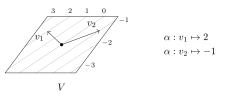
V is drawn as a plane with parallel gray level lines. Vectors v one and v two are assigned the values two and negative one by the functional alpha.
Let me spell out the map $V \cong V^\ast$ (after choosing a basis) more explicitly. Suppose $\dim_k V = n$ and choose an ordered basis $B = (v_1, v_2, \ldots, v_n)$. The assignment $\Phi(v_i) = e_i$ then gives an isomorphism
$$ \Phi : V \to k^n; \quad \sum_{i=1}^{n} a_i v_i \mapsto \sum_{i=1}^{n} a_i e_i = (a_1, \ldots, a_n), $$
where $e_i$ are the standard basis vectors. Using this isomorphism, we can construct a map

V maps by Phi to k to the n, then is identified with its dual, and finally maps to V dual by precomposition with Phi.
This is an isomorphism, because it is a composition of isomorphisms. At the least, we have the following.
If $V$ is finite-dimensional, then $V^\ast$ is finite-dimensional as well and $\dim_k V = \dim_k V^\ast$.
We constructed an (non-canonical) isomorphism between $V$ and $V^\ast$. (Check that $f \mapsto f \circ \Phi$ is an isomorphism.)
Let $v_i^\ast \in V^\ast$ be the image of $v_i$ under the above isomorphism. Show that
$$ v_i^\ast(v_j) = \begin{cases} 1 & i = j \\ 0 & i \neq j. \end{cases} $$
This can also be taken as the definition of $v_i^\ast$. One thing to be careful is that $v_i^\ast$ is not defined using only $v_i$. You need the entire basis $v_1, \ldots, v_n$ in order to define even a single $v_i^\ast$. The notation is highly misleading in this sense, but unfortunately it is used widely in mathematics. The following exercise will demonstrate to you how careful you need to be when doing computations with the dual vector space.
Let us take $V = \mathbb{R}^2$ with $k = \mathbb{R}$.
- (a)
Consider the ordered basis $e_1 = (1, 0)$ and $e_2 = (0, 1)$. There is an isomorphism $-^{\ast e} : V \to V^\ast$ corresponding to this ordered basis. (We have put the superscript $e$ to denote that it comes from $e_1, e_2$.) Write $e_1^{\ast e}$ and $e_2^{\ast e}$ as $1 \times 2$ matrices.
- (b)
Change one vector and take $v_1 = e_1 = (1, 0)$ and $v_2 = (1, 1)$. Consider the isomorphism $-^{\ast v} : V \to V^\ast$ corresponding to this ordered basis. Write $v_1^{\ast v}$ and $v_2^{\ast v}$ as $1 \times 2$ matrices.
- (c)
Note that $v_1^{\ast v} \neq e_1^{\ast e}$ even though $e_1 = v_1$. Express $e_1^{\ast v}$ and $e_2^{\ast v}$ as $1 \times 2$ matrices.
I hope the discussion above gives enough intuition about how dual spaces behave. Let us now discuss the more formal properties of the dual. Suppose we have a linear map $f : V \to W$ between vector spaces. This induces a map
$$ f^\ast : W^\ast \to V^\ast; \quad \alpha \mapsto \alpha \circ f. $$
We actually talked about this when discussing $\Hom_k$. In fact, dualizing is a special case of $\Hom_k$, so everything we have proven about $\Hom_k$ holds.
For vector spaces $V$ and $W$, show that there is a natural isomorphism $(V \oplus W)^\ast \cong V^\ast \oplus W^\ast$.
Consider a linear map $f : V \to W$ between vector spaces. If $f$ is injective, then $f^\ast$ is surjective. If $f$ is surjective, then $f^\ast$ is injective.
Let us first show that if $f$ is surjective then $f^\ast$ is injective. To check that $f^\ast : W^\ast \to V^\ast$ is injective, we only need to show that $\ker f^\ast = 0$. Consider any $\alpha \in W^\ast$ such that $f^\ast(\alpha) = \alpha \circ f = 0$. Then $\alpha(f(v)) = 0$ for all $v \in V$. Because $f$ is surjective, $f(v)$ ranges over all vectors in $W$. This shows that $\alpha(w) = 0$ for all $w \in W$, and hence $\alpha = 0$.
We now show that if $f$ is injective then $f^\ast$ is surjective. Given an arbitrary $\beta \in V^\ast$, we need to show that there exists an $\alpha \in W^\ast$ such that $f^\ast(\alpha) = \alpha \circ f = \beta$. By this condition $\alpha \circ f = \beta$, such a map $\alpha$ restricted to $f(V) \subseteq W$ is uniquely determined. That is, the map $\alpha_0 = \alpha \circ f^{-1} : f(V) \to k$ is well-defined, and $\alpha \circ f = \beta$ is equivalent to $\alpha \vert_{f(V)} = \alpha_0$. What we need to do is to extend this linear map $\alpha_0 : f(V) \to k$ to a linear map $\alpha : W \to k$. We do this by picking a basis. Let $B_1 \subseteq f(V)$ be a basis of $f(V)$. By Exercise 2.7.F, there exists a $B_2 \subseteq W$, disjoint from $B_1$, such that $B_1 \cup B_2$ is a basis of $W$. Let define $\alpha : W \to k$ by
$$ \alpha(b) = \alpha_0(b) \text{ if } b \in B_1, \quad \alpha(b) = 0 \text{ if } b \in B_2. $$
Because $\vspan B_1 = f(V)$ and $\alpha(b) = \alpha_0(b)$ for $b \in B_1$, we see that $\alpha \vert_{f(V)} = \alpha_0$. On the other hand, this clearly gives a linear map $W \to k$ because $B_1 \cup B_2$ is a basis of $W$.
Let $V_1 \to V_2 \to V_3$ be an exact sequence of vector spaces. Show that its dual $V_3^\ast \to V_2^\ast \to V_1^\ast$ is exact as well.
This actually holds in greater generality.
Let $V_1 \to V_2 \to V_3$ be an exact sequence of vector spaces. For an arbitrary vector space $W$, show that the induced sequence
$$ \Hom(V_3, W) \to \Hom(V_2, W) \to \Hom(V_1, W) $$
is exact.
This is not really relevant, but I think it's worth mentioning. Let $V_1 \to V_2 \to V_3$ be an exact sequence of vector spaces. For an arbitrary vector space $W$, show that the induced sequence
$$ \Hom(W, V_1) \to \Hom(W, V_2) \to \Hom(W, V_3) $$
is exact.
Consider a vector space $V$ and a vector $v \in V$. If $f(v) = 0$ for all linear maps $f : V \to k$, then show that $v = 0$.
Consider a vector space $V$ and a subset $S = \lbrace v_i \rbrace _{i \in I}$. For every vector $v \in V$, show that the following are equivalent:
- (i)
$v \notin \vspan(S)$.
- (ii)
There exists a $f \in V^\ast$ such that $f(v_i) = 0$ for all $v_i \in S$ but $f(v) \neq 0$.
Let $V$ be a vector space and $S = \lbrace v_i \rbrace _{i \in I} \subseteq V$ be a set of vectors. For $c_i \in k$, show that the following conditions are equivalent:
- (i)
The equations $f(v_i) = c_i$ for $i \in I$ do not have a common solution $f \in V^\ast$.
- (ii)
There exist $i_1, \ldots, i_n \in I$ and $a_1, \ldots, a_n \in k$ such that $a_1 v_{i_1} + a_2 v_{i_2} + \cdots + a_n v_{i_n} = 0$ but $a_1 c_{i_1} + \cdots + a_n c_{i_n} \neq 0$.
(Hint: extend $v_i$ to $\tilde{v}_i = (v_i, c_i) \in V \oplus k$. Then (i) is equivalent to the nonexistence of $f \in (V \oplus k)^\ast$ such that $f(\tilde{v}_i) = 0$ for all $i \in I$ and $f(0_V, 1) = -1$. Now use the previous exercise.)
For a linear $f : V \to W$, recall that we have defined $\rank f = \dim_k \im f$. If $\rank f < \infty$, i.e., $\im f$ is finite-dimensional, show that $\rank f = \rank f^\ast$. (Hint: if $f$ is decomposed as $f : V \twoheadrightarrow U \hookrightarrow W$, then show that $\rank f = \dim U$.)
Consider a linear map $T : k^n \to k^{m}$, corresponding to an $m \times n$ matrix with entries in $k$. Write
$$ T = \begin{bmatrix} t_{11} & \cdots & t_{1n} \\ \vdots & \ddots & \vdots \\ t_{m1} & \cdots & t_{mn} \end{bmatrix}. $$
Its dual is going to be $T^\ast : (k^m)^\ast \to (k^n)^\ast$, and under the isomorphisms $k^m \cong (k^m)^\ast$ and $k^n \cong (k^n)^\ast$, we can regard it as a linear map $T^\ast : k^m \to k^n$. Show that the $n \times m$ matrix corresponding to $T^\ast$ is
$$ T^\ast = \begin{bmatrix} t_{11} & \cdots & t_{m1} \\ \vdots & \ddots & \vdots \\ t_{1n} & \cdots & t_{mn} \end{bmatrix}. $$
This is also called the transpose matrix of $T$.
Consider a linear map $T : k^n \to k^m$, and consider it as an $m \times n$ matrix. Consider the columns of $T$ as elements of $k^m$, and denote them by $v_1, \ldots, v_n \in k^m$. We define the column rank as $\dim_k \vspan(v_1, \ldots, v_n)$. Show that the column rank of $T$ is simply $\rank T$, where $T$ is regarded as a linear map. Similarly, consider the rows of $T$ as $w_1, \ldots, w_m \in k^n$, and define the row rank as $\dim_k \vspan(w_1, \ldots, w_m)$. Show that the row rank of $T$ is $\rank T^\ast$. Conclude that
$$ \rank T = (\text{column rank of } T) = (\text{row rank of } T) $$
for any matrix $T$.
An element $\alpha \in V^\ast$ is, by definition, a linear map $V \to k$, so there is a “pairing” between $V$ and $V^\ast$ given by
$$ V^\ast \times V \to k; \quad (\alpha, v) \mapsto \alpha(v). $$
This map is not linear, because $(\alpha_1 + \alpha_2)(v_1 + v_2) \neq \alpha_1(v_1) + \alpha_2(v_2)$. Instead, it is linear when one component is fixed. This is called a “bilinear map”, which we will look at in the next chapter. The point is that the map is linear on $\alpha$ when $v \in V$ is fixed. That is, for each $v \in V$, we get a linear map
$$ -(v) : V^\ast \to k; \quad \alpha \mapsto \alpha(v). $$
This then gives a canonical map
$$ \Psi_V : V \to (V^\ast)^\ast; \quad v \mapsto -(v) = (\alpha \mapsto \alpha(v)). $$
Show that the map $\Psi_V$ is injective for every vector space $V$.
Show that if $V$ is finite-dimensional, then $\Psi_V$ is an isomorphism. (Hint: look at the dimension)
Unfortunately, if $V$ is infinite-dimensional, the map $\Psi_V$ is always injective but not surjective. From Exercise 2.8.A, we see that $(k^{\oplus S})^\ast$ can be identified with $k^S$. But if $S$ is infinite, there are many linear maps $k^{S} \to k$ that don't come from a pairing with an element of $k^{\oplus S}$. This is one reason we won't talk a lot about duals of infinite-dimensional vector spaces.
Let $V$ and $W$ be finite-dimensional vector spaces, and let $f : V \to W$ be a linear map. The map $f$ induces a map $f^\ast : W^\ast \to V^\ast$, which then induces $f^{\ast\ast} : V^{\ast\ast} \to W^{\ast\ast}$. Show that $f^{\ast\ast}$ is equal to $f$ under the identifications $V \cong V^{\ast\ast}$ and $W \cong W^{\ast\ast}$.

V maps to W by f and vertically to its double dual by Psi V. The bottom map f double dual leads to W double dual, connected vertically from W by Psi W.
Let $V$ and $W$ be finite-dimensional vector spaces. Show that the map
$$ \Hom_k(V, W) \to \Hom_k(W^\ast, V^\ast); \quad f \mapsto f^\ast $$
is an isomorphism of vector spaces.
Let $V$ be a finite-dimensional vector space, and let $W \subseteq V$ be a subspace. We define the annihilator of $W$ as the subspace
$$ W^0 = \lbrace \alpha \in V^\ast : \alpha(W) = 0 \rbrace \subseteq V^\ast. $$
- (a)
Show that $W^0 = \ker (i^\ast : V^\ast \to W^\ast)$, where $i : W \hookrightarrow V$ is the inclusion map.
- (b)
Show that $\dim V = \dim W + \dim W^0$.
- (c)
Show that $W^{00} \subseteq V^{\ast\ast}$ is equal to $W$ under the identification $V \cong V^{\ast\ast}$.
Let $V$ be a finite-dimensional vector space and $S = \lbrace f_i \rbrace _{i \in I} \subseteq V^\ast$ be a set of linear functionals. For $c_i \in k$, show that the following conditions are equivalent:
- (i)
The equations $f_i(v) = c_i$ for $i \in I$ do not have a common solution $v \in V$.
- (ii)
There exist $i_1, \ldots, i_n \in I$ and $a_1, \ldots, a_n \in k$ such that $a_1 f_{i_1} + a_2 f_{i_2} + \cdots + a_n f_{i_n} = 0$ but $a_1 c_{i_1} + \cdots + a_n c_{i_n} \neq 0$.