Section 2.6
Vector spaces from linear maps
In this section, we are going to construct vector spaces from linear maps.
Let $f : V \to W$ be a linear map between $k$-vector spaces. We define its kernel $\ker f$ and image $\im f$ as
$$ \begin{aligned} \ker f &= f^{-1}(0_W) = \lbrace v \in V : f(v) = 0 \rbrace \subseteq V, \\ \im f &= f(V) = \lbrace f(v) : v \in V \rbrace \subseteq W. \end{aligned} $$
Show that $\ker f$ is a subspace of $V$ and that $\im f$ is a subspace of $W$.
Show that any linear map $f : V \to W$ factors as $f : V \to \im f \to W$, where $V \twoheadrightarrow \im f$ is surjective and $\im f \hookrightarrow W$ is injective.
For a linear map $f : V \to W$, show that $f$ is injective if and only if $\ker f = \lbrace 0\rbrace $.
Let $f : V \to W$ be a linear map, and consider the natural map
$$ V / \ker f \to \im f; \quad [v] \mapsto f(v). $$
Show that this map is well-defined and is an isomorphism of vector spaces.
Let $f : V \to W$ be a linear map, and denote by $i : \ker f \to V$ the inclusion map. For an arbitrary vector space $U$ and a linear map $g : U \to V$ such that $f \circ g = 0$, show that there exists a unique map $h : U \to \ker f$ such that $g = i \circ h$.
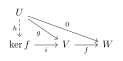
U maps by g to V and then by f to W with zero composite. A unique dashed h factors g through the inclusion of the kernel of f into V.
We are now going to make a definition that might seem very unmotivated. It will also be hard to visualize what it is supposed to mean. But my advice is not to try too hard to find geometric meaning in this object. This definition is going to be useful in a more formal, symbolic context.
Let $f : V \to W$ be a linear map. We define its cokernel as
$$ \coker f = W / \im f. $$
This makes sense because $\im f$ is a subspace of $W$.
This is supposed to be the dual notion of the kernel, and you can see this from the universal property. Note that there is a natural projection map $\pi : W \to W / \im f = \coker f$.
Let $f : V \to W$ be a linear map, and denote by $\pi : W \to \coker f$ the projection map. For an arbitrary vector space $U$ and a linear map $g : W \to U$ such that $g \circ f = 0$, show that there exists a unique map $h : \coker f \to U$ such that $g = h \circ \pi$.
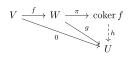
V maps by f to W, which projects to the cokernel of f. A map g from W to U with zero composite through f factors uniquely through the cokernel by a dashed map h.
Let $f : V \to W$ be a linear map. Show that there are natural isomorphisms $\ker(W \to \coker f) \cong \coker(\ker f \to V) \cong \im f$.
All these constructions are “functorial”, in the following sense. Suppose we have linear maps $f_i : V_i \to W_i$ and $\varphi_V : V_1 \to V_2$, $\varphi_W : W_1 \to W_2$ such that $\varphi_W \circ f_1 = f_2 \circ \varphi_V$.

V one maps to W one by f one and V two maps to W two by f two. Vertical maps phi V and phi W make the square commute.
We can extend on the left and right by looking at the kernels and cokernels of $f_i$. But then, we note that
$$ f_2 \circ (\varphi_V \circ \iota_1) = \varphi_W \circ f_1 \circ \iota_1 = \varphi_W \circ 0 = 0, $$
and therefore by the universal property of kernels, there exists a unique map $\ker f_1 \to \ker f_2$ that makes the diagram commute. Likewise,
$$ (\pi_2 \circ \varphi_W) \circ f_1 = \pi_2 \circ f_2 \circ \varphi_V = 0 \circ \varphi_V = 0, $$
and therefore there is a unique map $\coker f_1 \to \coker f_2$ that makes the diagram commute.
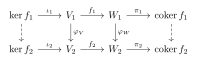
Two horizontal sequences run from a kernel through V and W to a cokernel. Vertical maps induced by phi V and phi W connect every corresponding term.
Let me also introduce the notion of exactness. This will probably not be helpful for us too much, but it is an extremely useful notion for keeping track of various data, once we start dealing with complicated situations. Also, wrapping your head around it will help you get familiar with all the notions we have been looking at so far.
A sequence of vector spaces and linear maps
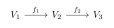
V one maps to V two by f one, which maps to V three by f two.
is said to be exact if $\ker f_2 = \im f_1$. More generally, a sequence

V zero maps successively through V one and intermediate terms to V n.
is said to be exact if $\ker f_{i} = \im f_{i-1}$ for all $1 \le i \le n-1$.
For $f_1 : V_1 \to V_2$ and $f_2 : V_2 \to V_3$, show that $\im f_1 \subseteq \ker f_2$ if and only if $f_2 \circ f_1 = 0$. As a consequence, if $V_1 \to V_2 \to V_3$ is exact, then the composite of the two maps is zero.
Show that a map $f : V \to W$ is injective if and only if the sequence $0 \to V \to W$ is exact. Likewise, show that $f$ is surjective if and only if the sequence $V \to W \to 0$ is exact.
An exact sequence that looks like $0 \to A \to B \to C \to 0$ is called a short exact sequence. In this case, $A \to B$ is an injection, so $A$ can be identified with a subspace of $B$. Show that $C$ is naturally isomorphic to $B / A$.
Consider the sequence

The first nonzero map is the column matrix with entries a and b, and the next is the row matrix with entries c and d.
Find the condition that this sequence is exact, in terms of $a$, $b$, $c$, and $d$.
Show that, for a linear map $f : V \to W$, the sequences
$$ 0 \to \ker f \to V \to \im f \to 0, \quad 0 \to \im f \to W \to \coker f \to 0 $$
are exact.
Show that, for a linear map $f : V \to W$, the sequence
$$ 0 \to \ker f \to V \to W \to \coker f \to 0 $$
is always exact. (In general, if $\cdots \to A_{-1} \to A_{0} \to B \to 0$ and $0 \to B \to A_1 \to A_2 \to \cdots$ are exact sequences, you can string them together to get an exact sequence $\cdots \to A_{-1} \to A_0 \to A_1 \to A_2 \to \cdots$.)
Do this exercise only if you feel super energetic. Consider a commutative diagram
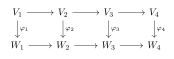
The top exact row V one through V four maps vertically by phi one through phi four to the bottom exact row W one through W four.
such that the two rows are exact sequences.
- (a)
If $\varphi_1$ and $\varphi_3$ are surjective, and $\varphi_4$ is injective, show that $\varphi_2$ is surjective.
- (b)
If $\varphi_2$ and $\varphi_4$ are injective, and $\varphi_1$ is surjective, show that $\varphi_3$ is injective.
Conclude that if
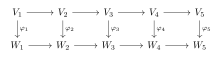
The top exact row V one through V five maps vertically by phi one through phi five to the bottom exact row W one through W five.
commutes and rows are exact, and $\varphi_1, \varphi_2, \varphi_4, \varphi_5$ are isomorphisms, then $\varphi_3$ is an isomorphism as well.
Before concluding this section, let me define another vector space.
Let $V$ and $W$ be two $k$-vector spaces. We define
$$ \Hom_k(V, W) = \lbrace k\text{-linear maps } f : V \to W \rbrace . $$
This as a structure of a vector space, given by
$$ (f + g)(v) = f(v) + g(v), \quad (cf)(v) = c f(v). $$
So $\Hom_k(V, W)$ is not just a set, but a $k$-vector space again. It can be checked that the addition and scalar multiplication satisfy all the axioms, with $0$ being the zero map $0 : V \to 0 \to W$.
For any $k$-vector space $V$, show that there is a natural isomorphism
$$ \Hom_k(k, V) \cong V; \quad f \mapsto f(1). $$
Let $\lbrace V_i\rbrace _{i \in I}$ be a set of $k$-vector spaces. For any $k$-vector space $W$, show that the natural linear map
$$ \Hom_k(W, {\textstyle \prod_{i \in I}^{} V_i}) \to \prod_{i \in I}^{} \Hom_k(W, V_i); \quad f \mapsto (\pi_i \circ f)_{i \in I} $$
is an isomorphism of vector spaces.
Let $\lbrace V_i\rbrace _{i \in I}$ be a set of $k$-vector spaces. For any $k$-vector space $W$, show that the natural linear map
$$ \Hom_k({\textstyle \bigoplus_{i \in I}^{} V_i}, W) \to \prod_{i \in I}^{} \Hom_k(V_i, W); \quad f \mapsto (f \circ \iota_i)_{i \in I} $$
is an isomorphism of vector spaces. As a consequence, there is a natural isomorphism $\Hom_k(k^{\oplus S}, V) \cong V^S$.
If $f : V_1 \to V_2$ is a linear map, and $W$ is an arbitrary $k$-vector space, there are induced maps
$$ \begin{aligned} f_\ast : \Hom_k(W, V_1) &\to \Hom_k(W, V_2); \quad \alpha \mapsto f \circ \alpha, \\ f^\ast : \Hom_k(V_2, W) &\to \Hom_k(V_1, W); \quad \alpha \mapsto \alpha \circ f. \end{aligned} $$
(In case you're wondering what lower and upper stars mean, lower star usually means that the direction of the order did not change, e.g., $V_1 \to V_2$ inducing $\Hom_k(-, V_1) \to \Hom_k(-, V_2)$. Upper star means that the direction did change, e.g., $V_2 \to V_2$ inducing $\Hom_k(V_2, -) \to \Hom_k(V_1, -)$.)
If $0 \to V_1 \to V_2 \to V_3$ is an exact sequence, show that the induced sequence
$$ 0 = \Hom_k(W, 0) \to \Hom_k(W, V_1) \to \Hom_k(W, V_2) \to \Hom_k(W, V_3) $$
is exact as well.
If $V_1 \to V_2 \to V_3 \to 0$ is an exact sequence, show that the induced sequence
$$ 0 = \Hom_k(0, W) \to \Hom_k(V_3, W) \to \Hom_k(V_2, W) \to \Hom_k(V_1, W) $$
is exact as well.