Section 3.3
The determinant
We finally get to define the determinant. Intuitively, the determinant measures the change of volume in the linear transformation. Let us look at an example. Consider the linear map $A : \mathbb{R}^2 \to \mathbb{R}^2$ defined by the matrix
$$ A = \begin{bmatrix} 1 & -1 \\ -2 & 0 \end{bmatrix}. $$
What this map does to the standard basis vectors is depicted in Figure 3.2. The area of the parallelogram defined by $e_1$ and $e_2$ gets orientation-reversed, and the area becomes twice. In fact, given any reasonable finite shape in $\mathbb{R}^2$, the map $A$ is going to reverse its orientation and double its volume. This suggests that the “factor of volume change” is some invariant of the map $A$ that does not depend on the choice of a basis.
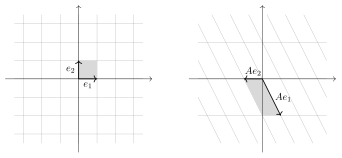
A linear map sends an oriented unit parallelogram in the plane to a parallelogram with twice the area and opposite orientation.
Consider a finite-dimensional vector space $V$ of dimension $\dim_k V = n$, and a linear map $f : V \to V$. Its $n$th exterior power $\extp^n V$ is a $1$-dimensional vector space, and
$$ f^{\wedge n} : \extp^n V \to \extp^n V $$
is a linear map. Thus this map $f^{\wedge n}$ is just multiplication by some scalar in $k$. We define the determinant of $f$ as the element $\det f \in k$ such that
$$ f^{\wedge n}(\omega) = (\det f) \cdot \omega. $$
There are some obvious facts directly following from this definition. Let $f, g : V \to V$ be linear maps, where $V$ is a finite-dimensional vector space of dimension $n$. Then
$$ \extp^n V \xrightarrow{f^{\wedge n} = \times (\det f)} \extp^n V \xrightarrow{g^{\wedge n} = \times (\det g)} \extp^n V $$
and $g^{\wedge n} \circ f^{\wedge n} = (g \circ f)^{\wedge n}$ shows that
$$ \det(g \circ f) = (\det g) (\det f). $$
This should be intuitively clear, because $\det$ is supposed to tell you how volume changes under the linear map.
Let $V$ be a finite-dimensional vector space with basis $v_1, \ldots, v_n$, and let $T : V \to V$ be a linear map.
$$ (T v_1) \wedge (T v_2) \wedge \cdots \wedge (T v_n) = (\det T) v_1 \wedge v_2 \wedge \cdots \wedge v_n. $$
Using Exercise 3.2.Q, conclude that $T$ is an isomorphism (i.e., invertible) if and only if $\det T \neq 0$.
Let $\sigma$ be a permutation of $\lbrace 1, 2, \ldots, n\rbrace $, and consider the map $f : k^n \to k^n$ defined by $f(e_i) = e_{\sigma(i)}$. Show that $\det f = \operatorname{sgn}(\sigma)$.
Let $V$ be a finite-dimensional vector space, and let $f : V \to V$ be a linear map. Show that $\det(f) = \det(f^\ast)$.
Compute the determinant of the map $A : k^2 \to k^2$ given by the matrix
$$ A = \begin{bmatrix} a & b \\ c & d \end{bmatrix} $$
in terms of $a, b, c, d$.
Now it would be nice to have a formula for the determinant of a general $n \times n$ matrix in terms of its entries. The purpose for looking for this formula is two-fold. Firstly, in terms of computations, it would be nice to have a general formula. If we ever get to do computations, such as checking that some identity holds, we could just write down the determinant, expand everything, and prove that the two sides are equal. Secondly, the mere existence of a formula is helpful from a theoretical perspective as well. If a formula that does not involve division exists, we could extend the definition to “number systems without division”. If we find out that the formula is a polynomial, we find out that the set of matrices with nonzero determinant forms an algebraic variety, for instance.
Hence let us look for the formula. We write the $i$th column of an $n \times n$ matrix $A$ by $a_{\bullet i}$, so that $A$ looks like
$$ A = \begin{bmatrix} \\ a_{\bullet 1} & \cdots & a_{\bullet n} \\ \, \end{bmatrix}. $$
Another way to say this is $a_{\bullet i} = A e_i \in k^n$. But anyways, from Exercise 3.3.A applied to the standard basis vectors, we have
$$ (\det A) e_1 \wedge \cdots \wedge e_n = (A e_1) \wedge \cdots \wedge (A e_n) = a_{\bullet 1} \wedge \cdots \wedge a_{\bullet n}. $$
Let us now expand the right hand side. We know, by definition, that $a_{\bullet j} = a_{1j} e_1 + \cdots + a_{nj} e_n$. So
$$ \begin{aligned} (\det A) (e_1 \wedge \cdots \wedge e_n) &= \biggl( \sum_{i_1=1}^{n} a_{i_1 1} e_{i_1} \biggr) \wedge \cdots \wedge \biggl( \sum_{i_n=1}^{n} a_{i_n n} e_{i_n} \biggr) \\ &= \sum_{i_1=1}^{n} \cdots \sum_{i_n=1}^{n} (a_{i_1 1} a_{i_2 2} \cdots a_{i_n n}) e_{i_1} \wedge \cdots \wedge e_{i_n}. \end{aligned} $$
We know that $e_{i_1} \wedge \cdots \wedge e_{i_n} = 0$ if any two of $i_1, \ldots, i_n$ are equal. Thus we may consider the sum as over $(i_1, i_2, \ldots, i_n)$ that is a permutation of $1, \ldots, n$. Then we can write
$$ (\det A) (e_1 \wedge \cdots \wedge e_n) = \sum_{\sigma}^{} a_{\sigma(1) 1} a_{\sigma(2) 2} \cdots a_{\sigma(n) n} e_{\sigma(1)} \wedge e_{\sigma(2)} \wedge \cdots \wedge e_{\sigma(n)}, $$
where $\sigma$ runs over permutations of $\lbrace 1, \ldots, n\rbrace $, i.e., bijective maps $\lbrace 1, \ldots, n\rbrace \to \lbrace 1, \ldots, n\rbrace $. But because taking $\wedge$ is alternating, we have $e_{\sigma(1)} \wedge \cdots \wedge e_{\sigma(n)} = \operatorname{sgn}(\sigma) e_1 \wedge \cdots \wedge e_n$. Therefore we get the following formula.
For $A : k^n \to k^n$ a matrix, we have
$$ \det A = \sum_{\sigma}^{} \operatorname{sgn}(\sigma) a_{\sigma(1) 1} a_{\sigma(2) 2} \cdots a_{\sigma(n) n}, $$
where $\sigma$ runs over all permutations of $\lbrace 1, \ldots, n\rbrace $.
The determinant of a matrix $A$ is an integer-coefficient polynomial in its entries $a_{ij}$.
Show that for any permutation $\sigma$, we have $a_{\sigma(1) 1} \cdots a_{\sigma(n) n} = a_{1 \sigma^{-1}(1)} \cdots a_{n \sigma^{-1}(n)}$. Deduce that the formula for the determinant can also be written as
$$ \det A = \sum_{\sigma}^{} \operatorname{sgn}(\sigma) a_{1 \sigma(1)} \cdots a_{n \sigma(n)}. $$
Using the matrix interpretation of the dual (i.e., transpose, see Exercise 2.8.L), show that $\det A = \det A^\ast$. This is another proof of Exercise 3.3.C.
Try to prove $\det(g \circ f) = \det(g) \det(f)$ for linear maps $f, g : k^n \to k^n$, directly from the formula. This is going to be a nice combinatorial exercise.
Let $V$ be a finite-dimensional vector space and let $f : V \to V$ be a linear map. Assume $W \subseteq V$ is a subspace satisfying $f(W) \subseteq W$. Let $g = f \vert_W : W \to W$ be the restriction of $f$ to $W$ and let $h : V/W \to V/W$ be the linear map defined by $[v] \mapsto [f(v)]$. (Check that this is well-defined.) Show that $\det(f) = \det(g) \det(h)$. (You can do this in two ways: abstractly, or by picking a basis and looking at the corresponding matrix.)
Here is another way to put the same statement: if $0 \to V \to W \to U \to 0$ is a short exact sequence of finite-dimensional vector spaces and $f_V : V \to V$, $f_W : W \to W$, $f_U : U \to U$ are linear maps making the following diagram commute, then $\det(f_W) = \det(f_V) \det(f_U)$.
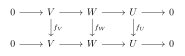
Two short exact rows from zero through V, W, and U back to zero are connected by vertical endomorphisms f V, f W, and f U.
Let $V$ be an $n$-dimensional vector space, and let $f : V \to V$ be a linear map. For any $c \in k$, show that
$$ \det(c \cdot \id + f) = \sum_{i=0}^{n} c^{n-i} \tr(f^{\wedge i} : \extp^i V \to \extp^i V). $$
(Hint: picking a basis sometimes makes life much easier.)
Let $k$ be a field of characteristic $0$. Consider a matrix $A : k^{2n} \to k^{2n}$, and assume that the matrix $A$ satisfies $a_{ij} = -a_{ji}$, i.e., $A^\ast = -A$ as matrices. Define the Pfaffian as
$$ \operatorname{pf}(A) = \frac{1}{2^n n!} \sum_{\sigma}^{} \operatorname{sgn}(\sigma) a_{\sigma(1) \sigma(2)} a_{\sigma(3) \sigma(4)} \cdots a_{\sigma(2n-1) \sigma(2n)}, $$
where $\sigma$ runs over all permutations of $\lbrace 1, \ldots, 2n\rbrace $.
- (a)
Show that if we define $\omega = \sum_{1 \le i < j \le 2n}^{} a_{ij} e_i \wedge e_j \in \extp^2 k^{2n}$, then
$$ \frac{1}{n!} \omega^{\wedge n} = \operatorname{pf}(A) e_1 \wedge e_2 \wedge \cdots \wedge e_{2n}. $$
- (b)
Show that $\det(A) = \operatorname{pf}(A)^2$.
Let $A, B, C, D : k^n \times k^n$ be $n \times n$ matrices such that $CD = DC$. Show that either $\det D = 0$ or the determinant of the $2n \times 2n$ matrix
$$ M = \begin{bmatrix} A & B \\ C & D \end{bmatrix} $$
is equal to $\det(AD - BC)$. (Hint: multiply and appropriate matrix $N$ on the right so that $\det N$ and $\det MN$ are easy to compute.)
Let $V$ and $W$ be finite-dimensional vector spaces and $f : V \to W$ and $g : W \to V$ be matrices. Show that $\det(\id_V + g \circ f) = \det(\id_W + f \circ g)$. (Hint: pick bases so that $f$ and $g$ are represented by $n \times m$ and $m \times n$ matrices $F$ and $G$. We then want to show that $\det(I_m + GF) = \det(I_n + FG)$. Show that both sides are equal to the determinant of $[\begin{smallmatrix} I_n & F \\ -G & I_m \end{smallmatrix}]$.)
Let $A, B, C, D : k^n \times k^n$ be $n \times n$ matrices such that $CD = DC$. Show that the determinant of the $2n \times 2n$ matrix
$$ M = \begin{bmatrix} A & B \\ C & D \end{bmatrix} $$
is equal to $\det(AD - BC)$. (Hint: Show that the identity for $M = [\begin{smallmatrix} A & B \\ C & (D + xI) \end{smallmatrix}]$ as a polynomial in $x$. Here, the determinant is a polynomial, so everything should be a polynomial in the variable $x$ and coefficients in $k$.)