Section 3.1
Bilinear maps and tensor products
Let $V$, $W$, and $U$ be $k$-vector spaces. A (set) map $f : V \times W \to U$ is said to be bilinear if
- (BL1)
for each $v \in V$, the map $f(v, -) : W \to U$ is linear, and
- (BL2)
for each $w \in W$, the map $f(-, w) : V \to U$ is linear.
Here, $V \times W$ is not supposed to thought of as a vector space. If you regard $V \times W$ as a vector space, the bilinear map $f$ isn't going to be linear in general. For example,
$$ f(c v, c w) = c f(v, c w) = c^2 f(v, w) $$
for $c \in k$.
Show that the set $\lbrace \text{bilinear } f : V \times W \to U \rbrace $ is a $k$-vector space under the usual operations
$$ (f + g)(v, w) = f(v, w) + g(v, w), \quad (cf)(v, w) = c f(v, w). $$
Consider the natural map
$$ \begin{aligned} \Hom_k(V, \Hom_k(W, U)) &\to \lbrace \text{bilinear } f : V \times W \to U \rbrace ; \\ f &\mapsto ((v, w) \mapsto f(v)(w)). \end{aligned} $$
Show that this map is an isomorphism of vector spaces. Likewise, show that the map
$$ \begin{aligned} \Hom_k(W, \Hom_k(V, U)) &\to \lbrace \text{bilinear } f : V \times W \to U \rbrace ; \\ f &\mapsto ((v, w) \mapsto f(w)(v)) \end{aligned} $$
is an isomorphism. In particular, we have a natural isomorphism
$$ \Hom_k(W, \Hom_k(V, U)) \cong \Hom_k(V, \Hom_k(W, U)). $$
For a vector space $V$, show that the map $V^\ast \times V \to k$ given by $(\alpha, v) \mapsto \alpha(v)$ is bilinear. For vector spaces $V, W$ and $\alpha \in V^\ast$, $\beta \in W^\ast$, show that the map
$$ V \times W \to k; \quad (v, w) \mapsto \alpha(v) \beta(w) $$
is bilinear.
Let us now try to classify bilinear maps. For instance, how is a bilinear map $f : k^2 \times k^2 \to V$ classified? We have
$$ \begin{aligned} f(a e_1 + b e_2, c e_1 + d e_2) &= a f(e_1, c e_1 + d e_2) + b f(e_2, c e_1 + d e_2) \\ &= ac f(e_1, e_1) + ad f(e_1, e_2) + bc f(e_2, e_1) + cd f(e_2, e_2), \end{aligned} $$
and thus $f$ is completely determined by the four values $f(e_i, e_j) \in V$. Conversely, for arbitrary choices of $f(e_i, e_j)$, the above map is bilinear, because every coefficient has exactly one of $a, b$ and exactly one of $c, d$. This shows that there is a correspondence
$$ \lbrace \text{bilinear } k^2 \times k^2 \to V \rbrace \to V^4; \quad f \mapsto (f(e_i, e_j))_{1 \le i, j \le 2}. $$
Another way to think about this is that
$$ \Hom_k(k^2, \Hom_k(k^2, V)) \cong \Hom_k(k^2, V^2) \cong (V^2)^2 \cong V^4. $$
Show that the map
$$ \lbrace \text{bilinear } k^m \times k^n \to V \rbrace \to V^{mn}; \quad f \mapsto (f(e_i, e_j))_{1 \le i \le m, 1 \le j \le n} $$
is an isomorphism of vector spaces.
These facts can also be stated as there being an isomorphism
$$ \lbrace \text{bilinear } k^m \times k^n \to V \rbrace \cong \lbrace \text{linear } k^{mn} \to V \rbrace . $$
This motivates the definition of tensor products.
Let $V$ and $W$ be vector spaces. If $\otimes : V \times W \to T$ is a bilinear map and satisfies the following property, we say that $T$ (along with the data of the bilinear map $\otimes : V \times W \to T$) is a tensor product: for any vector space $U$ and a bilinear map $b : V \times W \to U$, there exists a unique linear map $f : V \otimes W \to U$ such that $b = f \circ \otimes$.

V times W maps bilinearly to U by b and down to T by the tensor map. A unique dashed linear map f from T to U makes the triangle commute.
As with all universal properties, such a $T$, if it exists, is unique up to isomorphism. So we call $T$ the tensor product of $V$ and $W$, and write $T = V \otimes W$. We also write $\otimes(v, w) = v \otimes w$. An element of $V \otimes W$ is called a simple tensor if it is of the form $v \otimes w$ for some $v \in V$ and $w \in W$. (Simple tensors generally don't form a subspace of $T$.)
This is a weird definition, because we have characterized the tensor product as something satisfying a property. Such a definition is possible because any two objects satisfying the same universal property are canonically isomorphic. But the problem is that we do not know if there exists such a vector space $T$. If there is no such $T$ that satisfies the universal property, we would always have to worry about existence when writing $V \otimes W$.
For arbitrary vector space $V$ and $W$, their tensor product $V \otimes W$ always exists.
We are going to do something crazy. Note that a (set) map $b : V \times W \to U$ is the same as a linear map
$$ \Phi : k^{\oplus (V \times W)} \to U, $$
where $V \times W$ is regarded as a set in $k^{\oplus (V \times W)}$. (This is a super large vector space.) Here, $\Phi(\underline{v, w}) = b(v, w)$ by definition. We have the condition that $b$ is bilinear, which means that
$$ \begin{aligned} b(v + v^\prime, w) &= b(v, w) + b(v^\prime, w), \quad b(cv, w) = c b(v, w), \\ b(v, w + w^\prime) &= b(v, w) + b(v, w^\prime), \quad b(v, cw) = c b(v, w). \end{aligned} $$
In terms of $\Phi$, this can be translated to
$$ \begin{aligned} \Phi(\underline{v + v^\prime, w}) &= \Phi(\underline{v, w}) + \Phi(\underline{v^\prime, w}), \quad \Phi(\underline{cv, w}) = c \Phi(\underline{v, w}), \\ \Phi(\underline{v, w + w^\prime}) &= \Phi(\underline{v, w}) + \Phi(\underline{v, w^\prime}), \quad \Phi(\underline{v, cw}) = c \Phi(\underline{v, w}). \end{aligned} $$
So if we consider the subspace spanned by all such relations,
$$ X = \vspan \begin{Bmatrix} \underline{v + v^\prime, w} - \underline{v, w} - \underline{v^\prime, w}, \quad \underline{cv, w} - c \underline{v, w}, \\ \underline{v, w + w^\prime} - \underline{v, w} - \underline{v, w^\prime}, \quad \underline{v, cw} - c \underline{v, w} \end{Bmatrix} \subseteq k^{\oplus (V \times W)}, $$
the condition $b$ bilinear is equivalent to $\Phi(X) = 0$. That is, a bilinear map corresponds to a linear map $k^{\oplus (V \times W)} / X \to U$.
Now define $T = k^{\oplus (V \times W)} / X$, with $v \otimes w = [\underline{(v, w)}] \in T$. Then any bilinear map $b : V \times W \to U$ factors uniquely through $\otimes : V \times W \to T$, by the discussion above. That is, $T$ is the tensor product of $V$ and $W$.
This gives an explicit construction of $V \otimes W$, and it can be taken as the definition of $V \otimes W$. But we had to quotient a very large vector space by a very large subspace, so the definition by universal properties is more intuitive to understand. In fact, we are going to derive all properties of the tensor product from this universal property. But on the other hand, if you want a concrete idea, the above description can be useful. For instance, if
$$ v_1 \otimes w_1 + v_2 \otimes w_2 = v_3 \otimes w_3, $$
this means that $\underline{(v_1, w_1)} + \underline{(v_2, w_2)} - \underline{(v_3, w_3)} \in X$ and so the relation can be built out of basic bilinear operations like $v \otimes (w + w^\prime) = v \otimes w + v \otimes w^\prime$ or $(cv) \otimes w = c (v \otimes w)$.
Show that the natural map
$$ \Hom_k(V \otimes W, U) \to \Hom_k(V, \Hom_k(W, U)); \quad f \mapsto (v \mapsto (w \mapsto f(v \otimes w))) $$
is an isomorphism of vector spaces.
For an arbitrary vector space, show that the natural map
$$ V \to k \otimes V; \quad v \mapsto 1 \otimes v $$
is an isomorphism.
Show that $\dim (k^m \otimes k^n) = mn$.
Let $V$ and $W$ be two vector spaces, with bases $\lbrace v_i \rbrace _{i \in I}$ and $\lbrace w_j \rbrace _{j \in J}$. Then $\lbrace v_i \otimes w_j \rbrace _{i \in I, j \in J}$ is a basis of $V \otimes W$.
Let us first show that $v_i \otimes w_j$ generate $V \otimes W$. Because every $v \in V$ is a linear combination of $v_i$s and every $w \in W$ is a linear combination of $w_j$s, every $v \otimes w$ is a linear combinations of $v_i \otimes w_j$s. On the other hand, the construction in Proposition 3.1.3 immediately implies that $V \otimes W$ is generated by the simple tensors $v \otimes w$ for $v \in V$ and $w \in W$. This shows that $V \otimes W$ is generated by $v_i \otimes w_j$. (Here is another way to see this. Any linear map $f : V \otimes W \to U$ such that $f(v \otimes w) = 0$ has to be $0$ because the corresponding bilinear map $V \times W \to U$ is $0$. This shows that $V \otimes W$ is generated by $v \otimes w$.)
Now let us show that the vectors $v_i \otimes w_j$ are linearly independent. Suppose that
$$ \sum_{i \in I}^{} \sum_{j \in J}^{} a_{ij} (v_i \otimes w_j) = 0 \in V \otimes W, $$
where $a_{ij} = 0$ except for finitely many $(i, j) \in I \times J$. For each $i \in I$ and $j \in J$, there are functionals $v_i^\ast \in V^\ast$ and $w_j^\ast \in W^\ast$. Thus the map
$$ V \times W \to k; \quad (v, w) \mapsto v_i^\ast(v) w_j^\ast(w) $$
is bilinear, and corresponds to a linear map $f_{ij} : V \otimes W \to k$. This should satisfy $f_{ij}(v \otimes w) = v_i^\ast(v) w_j^\ast(w)$, and hence
$$ \begin{aligned} 0 &= f_{i_0 j_0}(0) = f_{i_0 j_0} \biggl( \sum_{i \in I}^{} \sum_{j \in J}^{} a_{ij} v_i \otimes w_j \biggr) \\ &= \sum_{i \in I}^{} \sum_{j \in J}^{} a_{ij} f_{i_0 j_0}(v_i \otimes w_j) = \sum_{i \in I}^{} \sum_{j \in J}^{} a_{ij} v_{i_0}^\ast(v_i) w_{j_0}^\ast(w_j) = a_{i_0 j_0}. \end{aligned} $$
Therefore all $a_{ij}$ are $0$, which means that $v_i \otimes w_j$ are linearly independent.
This also can be taken as a definition for the tensor product $V \otimes W$. But then the problem is that it depends on the choice of bases $\lbrace v_i \rbrace $ and $\lbrace w_j \rbrace $. One would have to check that a change of basis induces an isomorphism between the two tensor products, and this will not be fun.
If $V$ and $W$ are finite-dimensional vector spaces, then $V \otimes W$ is finite-dimensional and
$$ \dim_k (V \otimes W) = \dim_k V \cdot \dim_k W. $$
Let us now discuss some of the more formal properties of tensor products. Let $f : V \to W$ be a linear map and $U$ be an arbitrary vector space. We would like to say that $f$ induces a map
$$ f \otimes \id_U : V \otimes U \to W \otimes U; \quad v \otimes u \mapsto f(v) \otimes u. $$
How can we construct this map? The above is not really a definition because $v \otimes u$ covers only very special elements in $V \otimes U$. So we appeal to the universal property. Such a map should correspond to a bilinear map
$$ V \times U \to W \otimes U; \quad (v, u) \mapsto f(v) \otimes u, $$
and it is easy to check that this is indeed bilinear. By the universal property, it induces a linear map $f \otimes \id_U : V \otimes U \to W \otimes U$, and $f \otimes \id_U$ should satisfy $v \otimes u \mapsto f(v) \otimes u$ by definition.
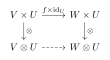
V times U maps to W times U by f times the identity and vertically to the corresponding tensor products. The induced bottom map is dashed.
This construction suggests that whenever I have an expression $E(v, w)$ that is bilinear in $v$ and $w$, the map
$$ V \otimes W \to (\text{sth}); \quad v \otimes w \mapsto E(v, w) $$
is always uniquely defined. Such a definition should be interpreted as the map $V \otimes W \to (\text{sth})$ induced from the bilinear map $V \times W \to (\text{sth})$ with $(v, w) \mapsto E(v, w)$.
For example, suppose I have $f : V_1 \to V_2$ and $g : W_1 \to W_2$. Then the map
$$ f \otimes g : V_1 \otimes W_1 \to V_2 \otimes W_2; \quad v \otimes w \mapsto f(v) \otimes g(w) $$
is a well-defined linear map.
Let $f_1 : V_1 \to V_2$, $f_2 : V_2 \to V_3$, $g_1 : W_1 \to W_2$, $g_2 : W_2 \to W_3$ be linear maps. Show that $(f_2 \otimes g_2) \circ (f_1 \otimes g_1) = (f_2 \circ f_1) \otimes (g_2 \circ g_1)$.
For vector spaces $V$ and $W$, show that the map
$$ V \otimes W \to W \otimes V; \quad v \otimes w \mapsto w \otimes v $$
is an isomorphism of vector spaces.
Let $V$, $W$, and $U$ be vector spaces. Rigorously define the linear map
$$ V \otimes (W \otimes U) \to (V \otimes W) \otimes U; \quad v \otimes (w \otimes u) \mapsto (v \otimes w) \otimes u $$
and show that it is an isomorphism. Then we are allowed to write $V \otimes W \otimes U$ without ambiguity.
Let $\lbrace V_i\rbrace _{i \in I}$ and $W$ be vector spaces. Show that the map
$$ \biggl( \bigoplus_{i \in I} V_i \biggr) \otimes W \to \bigoplus_{i \in I} (V_i \otimes W); \quad (v_i)_{i \in I} \otimes w \mapsto (v_i \otimes w)_{i \in I} $$
is an isomorphism. (The chain of isomorphisms
$$ \begin{aligned} \textstyle \Hom((\bigoplus_i V_i) \otimes W, X) &\cong \textstyle \Hom(\bigoplus_i V_i, \Hom(W, X)) \cong \prod_i \Hom(V_i, \Hom(W, X)) \\ &\cong \textstyle \prod_i \Hom(V_i \otimes W, X) \cong \Hom(\bigoplus_i (V_i \otimes W), X) \end{aligned} $$
suggests that the two should be isomorphic.)
Let $f : V \to W$ be a linear map and $U$ be a vector space, so that we have an induced linear map $f \otimes \id_U : V \otimes U \to W \otimes U$.
- (a)
Show that if $f$ is surjective, then $f \otimes \id_U$ is surjective.
- (b)
Show that if $f$ is injective, then $f \otimes \id_U$ is injective. (Hint: pick a basis of $U$.)
- (c)
Show that if $V \xrightarrow{f} W \xrightarrow{g} X$ is exact, then

V tensor U maps to W tensor U by f tensor the identity, then to X tensor U by g tensor the identity.
is exact. In particular, statements like $\ker(f \otimes \id_U) = (\ker f) \otimes U$ are true.
Here is another interesting construction. For $V$ and $W$ vector spaces, we can define a linear map.
$$ V^\ast \otimes W \to \Hom_k(V, W); \quad \alpha \otimes w \mapsto (\alpha(-) w : v \mapsto \alpha(v) w). $$
Assume that $V$ and $W$ are both finite-dimensional. Show that the natural map $V^\ast \otimes W \to \Hom_k(V, W)$ defined above is an isomorphism. (Hint: after comparing dimension, it suffices to show either injectivity or surjectivity.)
Let $V$ and $W$ be finite-dimensional vector spaces. Show that the natural map
$$ V^\ast \otimes W^\ast \to (V \otimes W)^\ast; \quad \alpha \otimes \beta \mapsto (v \otimes w \mapsto \alpha(v) \beta(w)) $$
is an isomorphism. (This is the same as $V^\ast \otimes W^\ast \to \Hom(V, W^\ast) \cong \Hom(V, \Hom(W, k)) \cong \Hom(V \otimes W, k) = (V \otimes W)^\ast$.)
Since we are working with finite-dimensional vector spaces, we can always write $\Hom_k$ out as tensor products. For instance, we can simplify a complicated expression like
$$ \begin{aligned} \Hom(\Hom(V, W), &\Hom(U, X)) \cong \Hom(V, W)^\ast \otimes \Hom(U, X) \\ &\cong (V^\ast \otimes W)^\ast \otimes (U^\ast \otimes X) \cong V^{\ast\ast} \otimes W^\ast \otimes U^\ast \otimes X \\ &\cong V \otimes W^\ast \otimes U^\ast \otimes X. \end{aligned} $$
But for infinite-dimensional vector spaces, the situation becomes complicated.
Let $V$ and $W$ be arbitrary vector spaces.
- (a)
Show that the natural map $V^\ast \otimes W \to \Hom_k(V, W)$ is always injective.
- (b)
Show that the image of $V^\ast \otimes W \to \Hom_k(V, W)$ is the subspace of $\Hom_k(V, W)$ consisting of finite rank linear maps $V \to W$.
Here is another interesting thing you can do. For a vector space $V$, we have seen that $V^\ast \times V \to k$ given by $(\alpha, v) \mapsto \alpha(v)$ is a bilinear map. This defines a linear map
$$ \tr_V : V^\ast \otimes V \to k; \quad \alpha \otimes v \mapsto \alpha(v). $$
For a finite-dimensional vector space $V$ and a linear map $f : V \to V$, we define the trace map
$$ \tr_V : \Hom_k(V, V) \cong V^\ast \otimes V \to k. $$
More generally, in view of Exercise 3.1.O, we can define the trace map as
$$ \tr_V : \lbrace \text{linear } f : V \to V \text{ with finite rank} \rbrace \cong V^\ast \otimes V \to k $$
even if $V$ is infinite-dimensional.
Because $\tr_V$ is linear, we have, in particular, $\tr(f + g) = \tr(f) + \tr(g)$ and $\tr(cf) = c \tr(f)$.
Consider a linear map $A : k^n \to k^n$ given by the matrix
$$ A = \begin{bmatrix} a_{11} & \cdots & a_{1n} \\ \vdots & \ddots & \vdots \\ a_{n1} & \cdots & a_{nn} \end{bmatrix}. $$
Show that $\tr(A) = a_{11} + \cdots + a_{nn}$.
For $V$ a finite-dimensional vector space and $f : V \to V$ a linear map, consider its dual map $f^\ast : V^\ast \to V^\ast$. Show that $\tr(f) = \tr(f^\ast)$.
Let $V$ be a finite-dimensional vector space. Consider linear maps $f, g : V \to V$, corresponding to $f, g \in V^\ast \otimes V$. Then $g \circ f$ is a liner map $V \to V$, and hence corresponds to $g \circ f \in V^\ast \otimes V$. Show that $g \circ f \in V^\ast \otimes V$ is the image of $f \otimes g \in V^\ast \otimes V \otimes V^\ast \otimes V$ under the map
$$ \id \otimes \tr \otimes \id : V^\ast \otimes (V \otimes V^\ast) \otimes V \to V^\ast \otimes k \otimes V \cong V^\ast \otimes V. $$
Let $V$ be a finite-dimensional vector space, and let $f, g : V \to V$ be linear maps. Show that $\tr(f \circ g) = \tr(g \circ f)$. (This can be done by picking a basis, but you can use the previous exercise to do it without picking bases.) This means that you can cyclically permute compositions, but not arbitrarily. For instance, $\tr(f \circ g \circ h) = \tr(g \circ h \circ f)$ but it is not equal to $\tr(f \circ h \circ g)$.
Let $V$ and $W$ be finite-dimensional vector spaces, and let $f : V \to V$ and $g : W \to W$ be linear maps. Show that $\tr(f \otimes g) = \tr(f) \tr(g)$. (Again, you are welcome to pick a basis, but you can do this without picking bases as well.)
Let $k$ have characteristic zero. For a finite-dimensional vector space $V$ and two maps $f, g : V \to V$, is it possible that $f \circ g - g \circ f = \id$? What if $k$ is allowed have positive characteristic?