Section 2.5
Subspaces and quotients
When we defined $k^{\oplus S}$, we defined it as a subset of $k^S$, and then gave the exactly same structure. We can consider this procedure in a more general setting.
Let $V$ be a $k$-vector space. Suppose that a subset $W \subseteq V$ satisfies
- (SS1)
$0 \in W$,
- (SS2)
$v_1, v_2 \in W$ implies $v_1 + v_2 \in W$,
- (SS3)
$v \in W$ implies $c v \in W$ for all $c \in k$.
Then $W$ inherits a $k$-vector space structure from $V$, with exactly the same addition and scalar multiplication.
In such a case, we say that $W$ is a subspace of $V$.
For instance, $k^{\oplus S}$ is a subspace of $k^S$ consisting of maps $f : S \to k$ such that $f(s) \neq 0$ for only finitely many $s$.
Show that any injective linear map $T : W \hookrightarrow V$ gives an isomorphism between $W$ and the image $T(W)$ as a subspace of $V$. Conversely, if $W$ is a subspace of $V$, show that the natural inclusion map $i : W \to V$ is an injective linear map.
If $W, U \subseteq V$ are subspaces, we can define
$$ W + U = \lbrace w + u : w \in W, u \in U \rbrace \subseteq V. $$
Show that if $W, U \subseteq V$ are subspaces, then $W + U$ and $W \cap U$ are also subspaces.
The subspace sum acts like a direct sum if the intersection is trivial Let $W, U \subseteq V$ be subspaces. The two inclusion maps $W, U \hookrightarrow W + U$ induce a linear map $W \oplus U \to W + U$ by the universal property of the direct sum. Show that this map is always surjective. If $W \cap U = \lbrace 0\rbrace $ then show that this map is an isomorphism. In such a case, we shall abuse notation to sometimes write $W \oplus U \subseteq V$ instead of $W + U$.
Show that it is false that if $W, U, X \subseteq V$ are subspaces, then $(W + U) \cap X = (W \cap X) + (U \cap X)$. Give a counterexample, and show that one always includes the other.
If $W \subseteq V$ is a subspace, we get the following equivalence relation on $V$:
$$ v_1 \sim v_2 \quad \Leftrightarrow \quad v_1 - v_2 \in W. $$
Check that this is an equivalence relation. (You have to check three things.)
For $W \subseteq V$ a subspace, we define the quotient of $V$ by $W$ as
$$ V / W = V / (v_1 \sim v_2 \Leftrightarrow v_1 - v_2 \in W), $$
with addition and multiplication defined as
$$ [v_1] + [v_2] = [v_1 + v_2], \quad c [v] = [cv]. $$
This definition of addition and multiplication requires some checking. We might worry that maybe $[v_1] = [v_3]$ and $[v_2] = [v_4]$ but $[v_1 + v_2] \neq [v_3 + v_4]$. If this happens, addition is not well-defined and we have a problem. But $[v_1] = [v_3]$ means that $v_1 \sim v_3$, which is equivalent to $v_1 - v_3 \in W$. Likewise $[v_2] = [v_4]$ means $v_2 - v_4 \in W$. Then $(v_1 + v_2) - (v_3 + v_4) = (v_1 - v_3) + (v_2 - v_4) \in W$ and so $[v_1 + v_2] = [v_3 + v_4]$. Likewise, if $[v] = [v_0]$ then $v - v_0 \in W$ and so $cv - cv_0 = c(v - v_0) \in W$ implies $[cv] = [cv_0]$. This shows that addition and scalar multiplication are well-defined operations on the quotient set $V/W$.
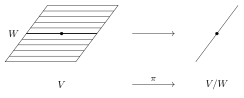
Parallel lines in V represent cosets of W. The projection pi collapses each line to one point in the quotient V modulo W.
The quotient can be thought of as “killing off” or “ignoring” or “collapsing” the $W$ part inside $V$. Anything that was in $W$ becomes $0$ in the quotient space $V / W$. There is a natural projection map
$$ \pi : V \to V/W; \quad v \mapsto [v], $$
and $\pi(v) = 0$ means that $[v] = [0] \in V / W$, and this means $v \in W$.
Show that the map $\pi : V \to V/W$ is always surjective. Conversely, show that if $f : V \twoheadrightarrow U$ any surjective linear map, then $U \cong V / f^{-1}(0)$ so that $f : V \to V / f^{-1}(0) \to U$ is a quotient map composed with an isomorphism.
Again, there is a universal property for quotients, which is the analogue of the universal property for quotienting out by equivalence relations.
Let $W \subseteq V$ be a subspace of a $k$-vector space. For an arbitrary $k$-vector space $U$ and a linear map $f : V \to U$ such that $f(w) = 0$ for all $w \in W$, prove that there exists a unique linear map $g : V/W \to U$ such that $f = g \circ \pi$.

V maps to U by f and projects to V modulo W by pi. A unique dashed map g from V modulo W to U makes f equal g after pi.
For $W \subseteq V$ a subspace, show that $V / W \cong 0$ as vector spaces if and only if $W = V$.
Let $W, U \subseteq V$ be subspaces. Show that there is a natural isomorphism
$$ (W + U) / U \to W / (W \cap U); \quad [w + u] \mapsto [w]. $$
Be careful about what each $[-]$ means!
Let $U \subseteq W \subseteq V$ be subspaces. Then $W / U$ can be regarded as a subspace of $V / U$, via the injective linear map $W/U \hookrightarrow V/U$; $[w] \mapsto [w]$. Show that the natural map
$$ V / W \to (V/U) / (W/U); \quad [v] \mapsto [[v]] $$
is well-defined and is an isomorphism. Again, be careful about $[-]$.