Section 3.2
Symmetric and exterior algebras
In this section, we look at variants of the tensor product. We have defined $V \otimes V$ to be the vector space that classifies bilinear maps mapping out of $V \times V$. But because the first and second components are both $V$, we can ask for additional properties for such bilinear maps, and try to come up with spaces classifying them. But first let us extend the notion of bilinearity to multilinearity.
Given vector spaces $V_1, \ldots, V_n$ and $W$, we say that a (set) map $f : V_1 \times V_2 \times \cdots \times V_n \to W$ is multilinear if for every $v_1 \in V_1, \ldots, v_n \in V_n$, the map
$$ f(v_1, \ldots, v_{i-1}, -, v_{i+1}, \ldots, v_n) : V_i \to W $$
is linear.
Show that $V_1 \otimes \cdots \otimes V_n$ classifies multilinear maps out of $V_1 \times \cdots \times V_n$. More concretely, given any multilinear $m : V_1 \times \cdots \times V_n \to W$, show that there exists a unique linear map $f : V_1 \otimes \cdots \otimes V_n \to W$ such that $m(v_1, \ldots, v_n) = f(v_1 \otimes \cdots \otimes v_n)$.
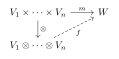
The product of V one through V n maps multilinearly to W and down to their tensor product. A unique dashed linear map f completes the triangle.
As we have said earlier, if $V_1 = \cdots = V_n$, then there are additional properties we can impose. In particular, we shall consider symmetry and anti-symmetry.
Let $V$ and $W$ be vector spaces. A multilinear map $f : V^n \to W$ is said to be symmetric if
$$ f(v_1, \ldots, v_n) = f(v_{\sigma(1)}, \ldots, v_{\sigma(n)}) $$
for all permutations $\sigma$ of $\lbrace 1, \ldots, n\rbrace $ and $v_1, \ldots, v_n \in V$.
Let $\alpha, \beta \in V^\ast$ be two linear functionals. Show that
$$ V \times V \to k; \quad (v, w) \mapsto \alpha(v) \beta(w) $$
is symmetric if and only if $\alpha$ and $\beta$ are linearly dependent.
In a similar way, let us define anti-symmetric, or alternating, maps. When $n = 2$, a map alternating should mean something like $f(v, w) = -f(w, v)$. For more variables, we need the notion of a signature of a permutation.
For $\sigma$ a permutation of the set $\lbrace 1, 2, \ldots, n\rbrace $, we define its signature as
$$ \operatorname{sgn}(\sigma) = (-1)^{\# \lbrace (i, j) : 1 \le i < j \le n, \sigma(i) > \sigma(j) \rbrace }. $$
We say that a permutation $\tau$ of $\lbrace 1, \ldots, n\rbrace $ is a transposition if there exist $1 \le i < j \le n$ such that $\tau(i) = j$ and $\tau(j) = i$ and $\tau(k) = k$ for $k \neq i, j$. Show that every permutation can be written as a composition of transpositions.
If $\sigma$ is a permutation of $\lbrace 1, \ldots, n\rbrace $ and $\tau$ is a transposition, show that $\operatorname{sgn}(\sigma \circ \tau) = -\operatorname{sgn}(\sigma)$. Deduce that if $\sigma$ is a composition of $m$ transpositions, then $\operatorname{sgn}(\sigma) = (-1)^m$. Show that $\operatorname{sgn}(\sigma_1 \circ \sigma_2) = \operatorname{sgn}(\sigma_1) \operatorname{sgn}(\sigma_2)$ for permutations $\sigma_1$ and $\sigma_2$ of $\lbrace 1, \ldots, n\rbrace $.
Let $V$ and $W$ be vector spaces. A multilinear map $f : V^n \to W$ is said to be skew-symmetric or anti-symmetric or alternating if
$$ f(v_1, \ldots, v_n) = 0 $$
for $v_1, \ldots, v_n \in V$ with $v_i = v_j$ for some $i < j$.
Show that if $f : V^n \to W$ is an alternating map, then
$$ f(v_1, \ldots, v_i, \ldots, v_j, \ldots, v_n) = -f(v_1, \ldots, v_j, \ldots, v_i, \ldots, v_n). $$
That is, switching two elements change the sign. (Hint: consider $f(\ldots, v_i + v_j, \ldots, v_i + v_j, \ldots)$.) Deduce that
$$ f(v_{\sigma(1)}, \ldots, v_{\sigma(n)}) = \operatorname{sgn}(\sigma) f(v_1, \ldots, v_n) $$
for vectors $v_1, \ldots, v_n \in V$ and a permutation $\sigma$ of $\lbrace 1, \ldots, n\rbrace $.
But the condition $f(v_{\sigma(1)}, \ldots, v_{\sigma(n)}) = \operatorname{sgn}(\sigma) f(v_1, \ldots, v_n)$ does not imply that $f$ is alternating. If $k$ has characteristic $2$, that is if $2 = 0$ inside $k$, then $\operatorname{sgn}(\sigma) = 1$ for all $\sigma$ and thus there is no guarantee that $f(v, v) = 0$. On the other hand if $\operatorname{char} k \neq 2$, it is straightforward to see that the two conditions are equivalent.
We are now ready to define the symmetric and exterior powers.
Let $V$ be a vector space. Suppose $S$ is a vector space along with a multilinear symmetric map $\cdot : V^d \to S$ such that for any other vector space $W$ and a multilinear symmetric map $s : V^d \to W$, there exists a unique linear map $f : S \to W$ such that $s = f \circ \cdot$.

V to the d maps symmetrically to W and down to S by multiplication. A unique dashed linear map f from S to W completes the triangle.
Then we say that $S$ is the symmetric power of $V$, and write $S = \Sym^d V$. We also write $\cdot (v_1, \ldots, v_d) = v_1 \cdots v_d$, because permuting $v_1, \ldots, v_d$ does not change the product.
Show that the symmetric power $\Sym^d V$ always exists. (Hint: Imitate the construction of the tensor product.)
Let $\lbrace v_i\rbrace _{i \in I}$ be a basis of $V$, where we assume that there is a total ordering of $I$. (Feel free to assume that $I$ is finite.) Show that the set
$$ \lbrace v_{i_1} v_{i_2} \cdots v_{i_d} : i_1 \le \ldots \le i_d \rbrace $$
is a basis of $\Sym^d V$. (Hint: for linear independence, imitate the proof of Proposition 3.1.4.)
Let $V$ be a finite-dimensional vector space with dimension $\dim_k V = n$. Show that $\Sym^d V$ is finite-dimensional as well and that $\dim_k \Sym^d V = \binom{d+n-1}{d}$.
The way to think about symmetric powers is as polynomials. For instance, let us consider $V = k^n$ with basis $\lbrace e_1, \ldots, e_n\rbrace \subseteq V$. The symmetric power $\Sym^d V$ will have basis
$$ \lbrace e_1^{d_1} e_2^{d_2} \cdots e_n^{d_n} : d_i \ge 0 \text{ and } d_1 + d_2 + \cdots + d_n = d \rbrace \subseteq \Sym^d V. $$
That is, $\Sym^d V$ looks like the homogeneous total degree $d$ polynomials in the variables $e_1, \ldots, e_n$. This analogy can be pushed further.
Let $V$ be a vector space. We define the symmetric algebra on $V$ as
$$ \Sym^\bullet V = \bigoplus_{d = 0}^{\infty} \Sym^d V. $$
(Here, $\Sym^0 V = k$ if you think over the definition carefully.)
Then this is the direct sum of all the homogeneous polynomials, and therefore is like the space of all polynomials in the variables $e_1, \ldots, e_n$. A typical element in $\Sym^\bullet V$ will look like $1 + 2 e_2^2 + 3 e_1^2 e_3 - 2 e_1 e_4^2$.
We can even multiply elements in $\Sym^\bullet V$ together. Consider the linear map
$$ \Sym^d V \otimes \Sym^e V \to \Sym^{d+e} V; \quad (v_{i_1} \cdots v_{i_d}, v_{j_1} \cdots v_{j_e}) \mapsto v_{i_1} \cdots v_{i_d} v_{j_1} \cdots v_{j_e}. $$
This is well-defined, and is going to be the analogue of “multiplication” of polynomials. We then get an isomorphism
$$ \lbrace \text{polynomials in the variables } e_1, \ldots, e_n \rbrace \quad \longleftrightarrow \quad \Sym^\bullet k^n $$
which not only is an isomorphism of vector spaces, but also preserves the “multiplication” structure. (A vector space with a multiplication structure is called an algebra, so this is an isomorphism of algebras.)
If $V$ is just a finite-dimensional vector space, without a canonical isomorphism to $k^n$, we can still talk about $\Sym^\bullet V$. But this symmetric algebra will not be identified with a polynomial algebra without choosing a basis for $V$. This can be a useful construction, for instance, in algebraic geometry.
Show that a linear map $f : V \to W$ induces linear maps $f^d : \Sym^d V \to \Sym^d W$ on each degree $d$. Also show that the map $f^\bullet : \Sym^\bullet V \to \Sym^\bullet W$ preserves multiplication. Show that this induced map behaves well with composition, i.e., if $g : W \to U$ is another linear map then $(g \circ f)^\bullet = g^\bullet \circ f^\bullet$.
Let $0 \to V \to W \to U \to 0$ be an exact sequence. Is
$$ 0 \to \Sym^d V \to \Sym^d W \to \Sym^d U \to 0 $$
necessarily exact?
To us, the exterior power, classifying alternating maps, will be more important. The definition of the exterior power is almost identical to the definition of the symmetric power, except for that symmetric is replaced with alternating.
Let $V$ be a vector space. Suppose $E$ is a vector space along with a multilinear alternating map $\wedge : V^d \to E$ such that for any other vector space $W$ and a multilinear alternating map $a : V^d \to W$, there exists a unique linear map $f : E \to W$ such that $a = f \circ \wedge$.

V to the d maps alternatingly to W and down to E by the wedge map. A unique dashed linear map f from E to W completes the triangle.
Then we say that $E$ is the exterior power of $V$, and write $E = \extp^d V$. We also write $\wedge (v_1, \ldots, v_d) = v_1 \wedge \cdots \wedge v_d$.
Show that the exterior power $\extp^d V$ always exists.
Let $V$ be a vector space with basis $\lbrace v_i \rbrace _{i \in I}$, and assume that $I$ is totally ordered. (Again, you can assume that $V$ is finite-dimensional.) Show that
$$ \lbrace v_{i_1} \wedge v_{i_2} \wedge \cdots \wedge v_{i_d} : i_1 < i_2 < \cdots < i_d \rbrace $$
is a basis of $\extp^d V$.
Let $V$ be a finite-dimensional vector space with $\dim_k V = n$. Show that $\extp^d V$ is finite-dimensional with dimension $\dim_k \extp^d V = \binom{n}{d}$.
Let $V = k^3$. The vector space $V$ has basis $\lbrace e_1, e_2, e_3\rbrace $, and the vector space $\extp^2 V$ has basis $\lbrace e_1 \wedge e_2, e_2 \wedge e_3, e_3 \wedge e_1\rbrace $. We then define a linear map, called the Hodge star operator, as
$$ \star : \extp^2 V \to V; \quad e_1 \wedge e_2 \mapsto e_3, \quad e_2 \wedge e_3 \mapsto e_1, \quad e_3 \wedge e_1 \mapsto e_2. $$
Show that for two vectors $v, w \in k^3$, their cross product $v \times w$ is equal to $\star(v \wedge w)$. (If you don't know what a cross product is, take this as a definition and compute the components of $v \times w$ in terms of $v_1, v_2, v_3$ and $w_1, w_2, w_3$.)
How should we think about the exterior power $\extp^d V$? The point of the exterior power is that there is some notion of orientation to it; if you switch two vectors, you flip the orientation and pick up a sign. The interpretation is that $\extp^d V$ is supposed to be a $d$-dimensional volume element in the vector space $V$. You can think of $v_1 \wedge \cdots \wedge v_d$ as the volume element corresponding to the $d$-dimensional parallelotope with $v_1, \ldots, v_d$ as sides. If two of these vectors are equal, the parallelotope becomes degenerate, and so the corresponding volume element becomes zero. If two vectors are switched, the orientation of the parallelotope is flipped and we get a minus sign.
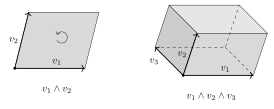
The left drawing shows two vectors spanning an oriented parallelogram for an exterior square. The right shows three vectors spanning an oriented parallelepiped for an exterior cube.
Like with the symmetric powers, we can define multiplication between elements of exterior powers. Consider the linear map
$$ \extp^d V \otimes \extp^e V \to \extp^{d+e} V; \quad (v_1 \wedge \cdots \wedge v_d, w_1 \wedge \cdots \wedge w_e) \mapsto v_1 \wedge \cdots \wedge v_d \wedge w_1 \wedge \cdots \wedge w_e. $$
For a vector space $V$, we define its exterior algebra as the vector space
$$ \extp^\bullet V = \bigoplus_{d = 0}^\infty \extp^d V $$
along with the multiplication maps defined above. (Here, $\extp^0 V = k$ if you go back to the definition.)
For $\alpha \in \extp^d V$ and $\beta \in \extp^e V$, we shall simply denote by $\alpha \wedge \beta$ their product in $\extp^{d+e} V$. For instance, we can do computations like
$$ \begin{aligned} (v_1 \wedge v_2 &- 2 v_2 \wedge v_3) \wedge (v_1 + v_3) \\ &= v_1 \wedge v_2 \wedge v_1 + v_1 \wedge v_2 \wedge v_3 - 2 v_2 \wedge v_3 \wedge v_1 - 2 v_2 \wedge v_3 \wedge v_3 \\ &= v_1 \wedge v_2 \wedge v_3 - 2 v_1 \wedge v_2 \wedge v_3 = -v_1 \wedge v_2 \wedge v_3. \end{aligned} $$
for $d = 2$ and $e = 1$.
Let $\alpha \in \extp^d V$ and $\beta \in \extp^e V$. Show that $\alpha \wedge \beta = (-1)^{de} \beta \wedge \alpha$ as elements of $\extp^{d+e} V$.
Let $d$ be an odd positive integer. Show that $\alpha \wedge \alpha = 0$ for every $\alpha \in \extp^d V$, even if $k$ has characteristic $2$ so that division by $2$ is not allowed.
Show that vectors $v_1, \ldots, v_d \in V$ are linearly independent if and only if $v_1 \wedge \cdots \wedge v_d \neq 0$ in $\extp^d V$. (Hint: Exercise 2.7.F.) The geometric interpretation is that a parallelotope is degenerate if and only if the side vectors are linearly dependent.
Of course, a linear map $f : V \to W$ induces a linear map
$$ f^{\wedge d} : \extp^d V \to \extp^d W; \quad v_1 \wedge \cdots \wedge v_d \mapsto f(v_1) \wedge \cdots \wedge f(v_d). $$
Verify that if $f : V \to W$ and $g : W \to U$ are linear maps, then $g^{\wedge d} \circ f^{\wedge d} = (g \circ f)^{\wedge d}$. Also show that $f^{\wedge \bullet} : \extp^\bullet V \to \extp^\bullet W$ preserves multiplication.
For vector spaces $V$ and $W$, find natural isomorphisms
$$ \begin{aligned} \Sym^d (V \oplus W) &\cong \bigoplus_{i=0}^{d} \Sym^i V \otimes \Sym^{d-i} W, \\ \extp^d (V \oplus W) &\cong \bigoplus_{i=0}^{d} \extp^i V \otimes \extp^{d-i} W. \end{aligned} $$
For a finite-dimensional vector space $V$, show that the linear map
$$ \begin{aligned} \extp^d V^\ast &\to (\extp^d V)^\ast; \\ \alpha_1 \wedge \cdots \wedge \alpha_d &\mapsto \biggl(v_1 \wedge \cdots \wedge v_d \mapsto \sum_{\sigma}^{} \operatorname{sgn}(\sigma) \alpha_1(v_{\sigma(1)}) \cdots \alpha_d(v_{\sigma(d)})\biggr) \end{aligned} $$
where $\sigma$ ranges over all permutations of $\lbrace 1, \ldots, d\rbrace $, is well-defined and an isomorphism. Thus an element of $\extp^d V^\ast$ inputs a $d$-dimensional volume form and outputs a number. It can then be thought of as something that can measure volume.